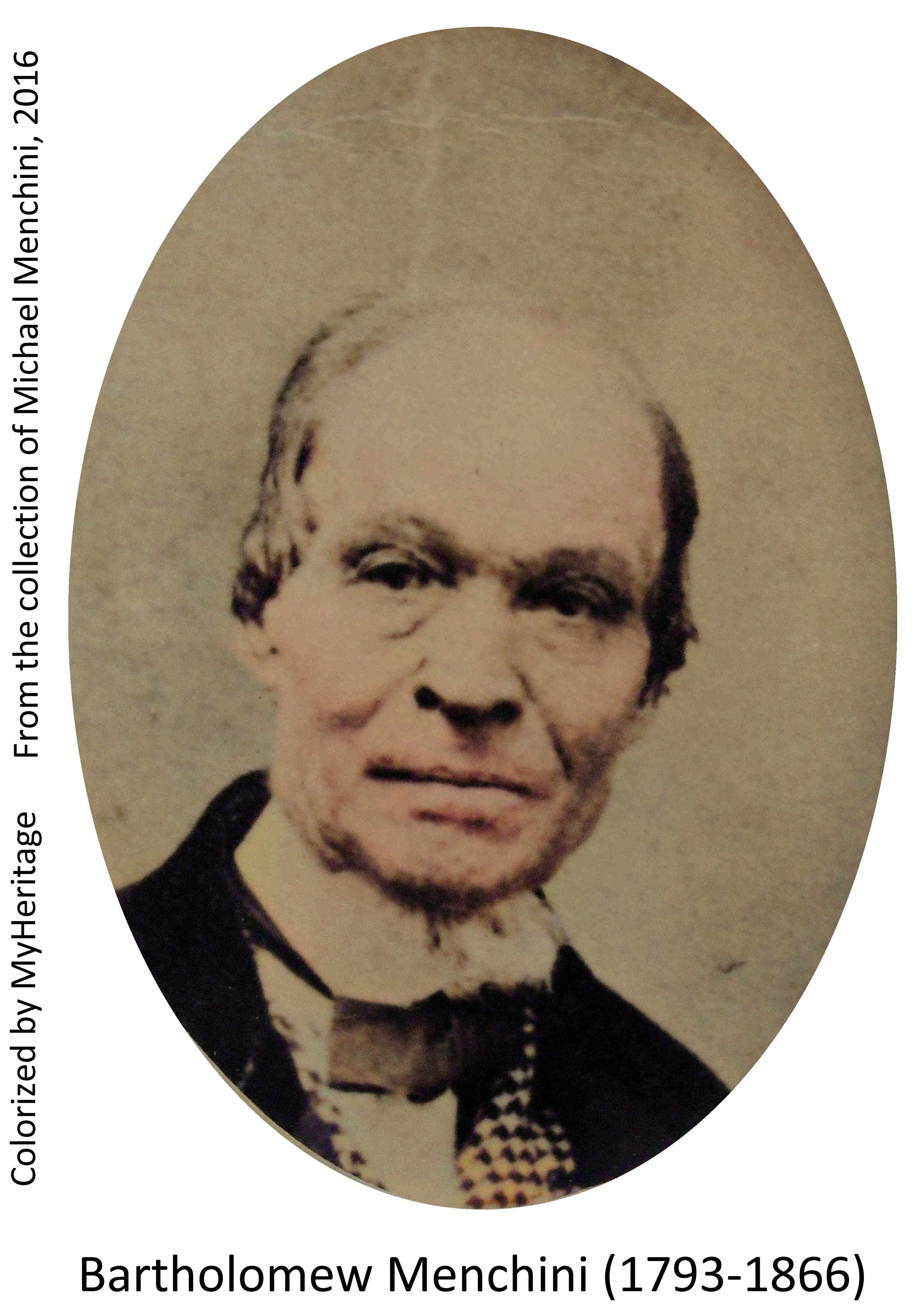
Bartholomew Menchini
(1793-1866)
| Catalani Project |
Bartholomew Menchine and Louisa Lilbourn
by Conrad & Judy Terrill, last edited 3 Dec. 2023
Click on an image to access a high-resolution version
Parts of this story are based on a one-page history called "George Menchine 'Forty-Niner'," written by William George Menchine (1870-1935), son of George (the 49er), in 1930, and shared with us in 2016 by W.G.'s grandson, also named William George ("Will") Menchine. The dates in this story do not quite jibe with what we've found in records, but they're not far off. We'll refer to this henceforth as "Forty-Niner." According to Will, his family has always pronounced "Menchine" as "Men-SHEEN", and "Menchini" as "Men-KEE-nee".
You can find most of the records upon which this story is based in our "A records history for the Bartholomew Menchine and Louise Lilbourne family," listed in chronological order.
|
Bartholomew Menchini |
Bartholomew Menchini was born 6 April 1793, in Italy according to most records, although one, his death record, gives France. Louisa Lilbourne was born 5 April 1802, in England according to most records, although one record gives Wales. z1 We do not know the names of the parents of either Bartholomew or Louisa, and we know almost nothing about their early lives, except what we've been able to deduce in the case of Bartholomew.
Bartholomew and Louisa, both of the Church of England parish of Rye, Sussex, a small seaside town two miles upriver from the English Channel in southeast England, were married by banns at the parish church on 22 May 1818. This was the first marriage for each of them. Bartholomew was 25, Louisa was about 16. They signed with their marks, '+' for Bartholomew, 'x' for Louisa. Will Menchine has heard that the couple were estranged from their families for marrying outside their faith or ethnicities. Their first child, daughter Siderina, was baptised at Rye on 23 March 1819, with Bartholomew's occupation given in the record as "merchant." Their second child, daughter Angeline, was also baptised there, on 20 March 1822. This time Bartholomew's occupation was given as "image maker."
|
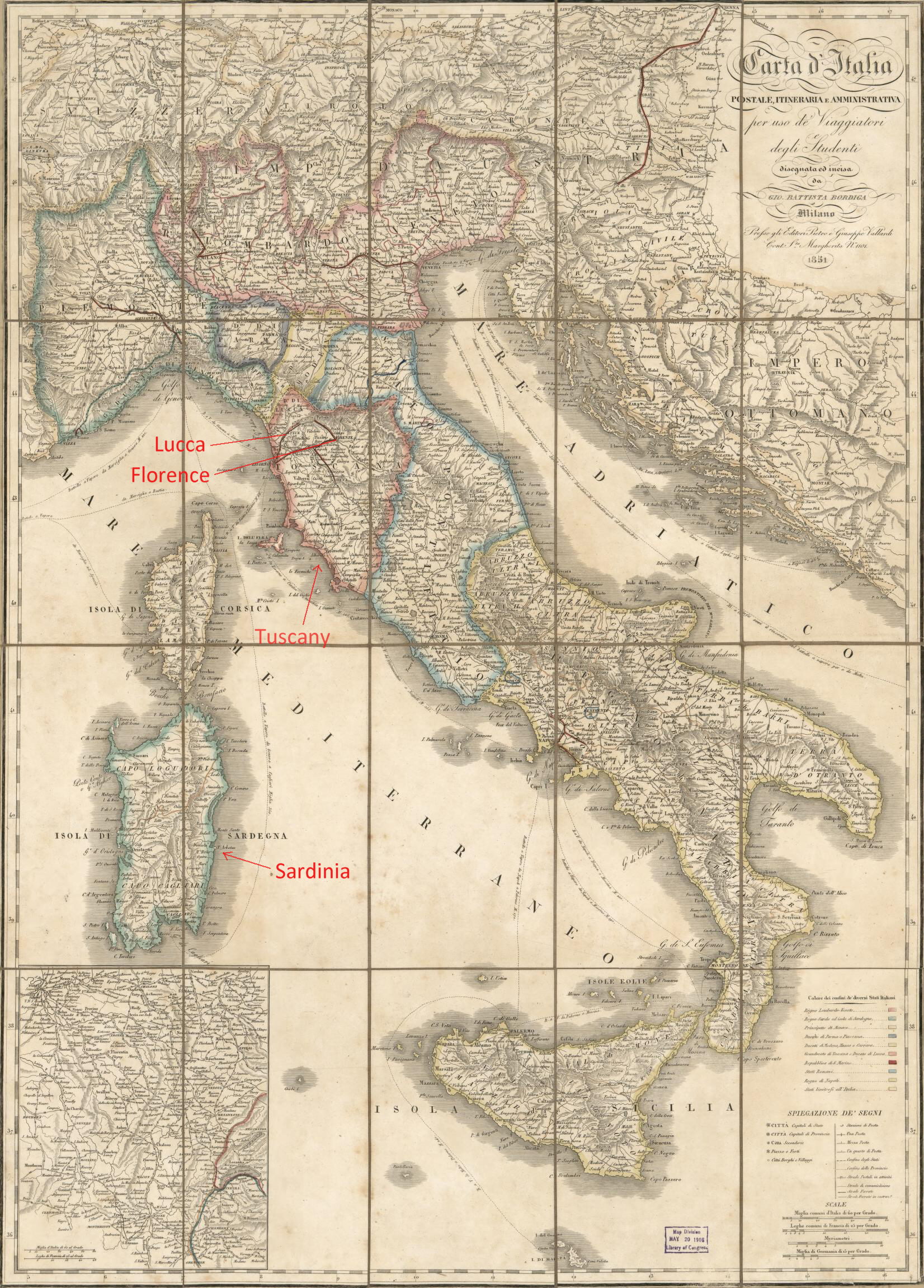
Italy, 1851 |
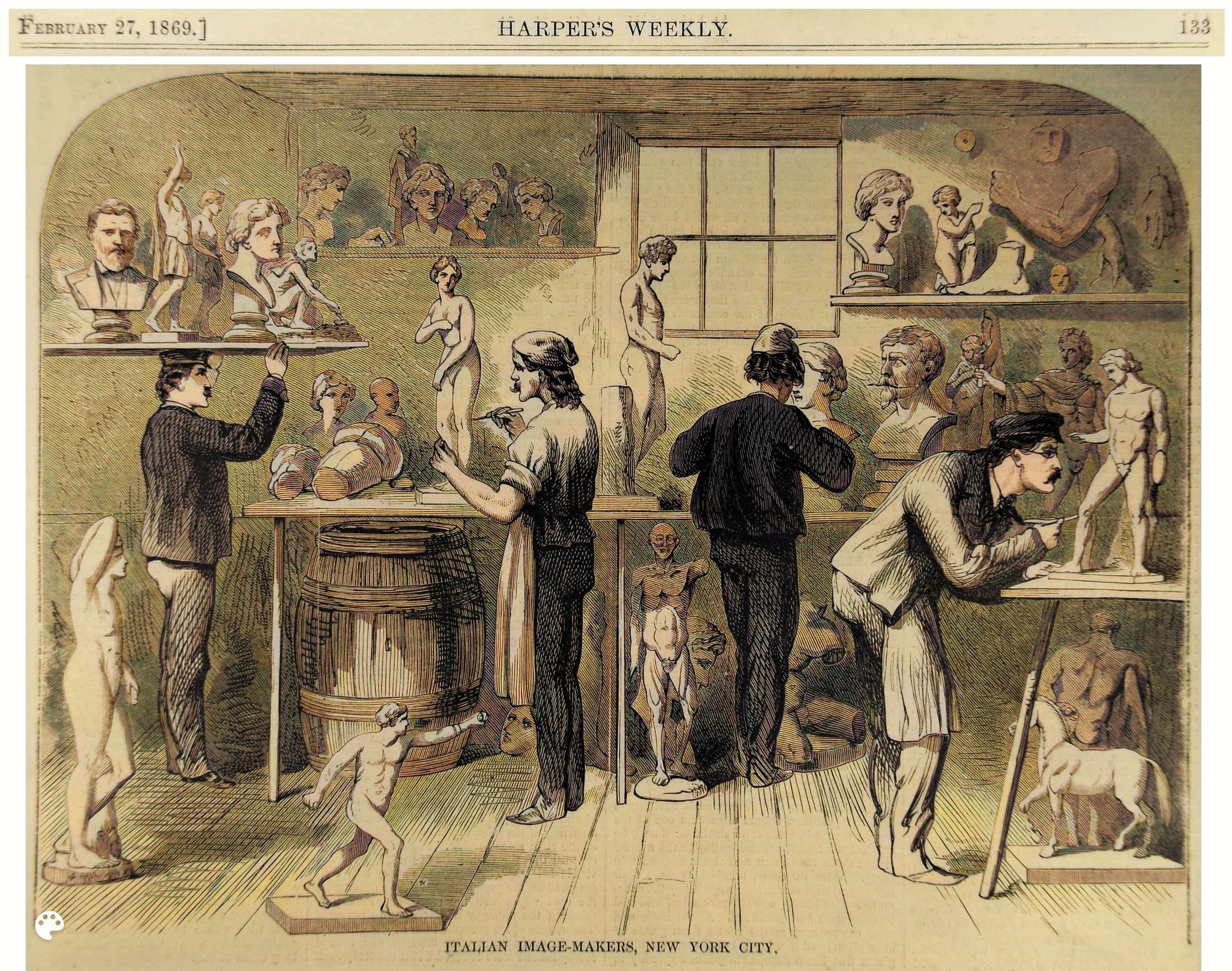
That Bartholomew's occupation was "image maker" seemed ambiguous at first. What, exactly, was meant? It surprised us how much we learned when Judy thought to Google the term. In all the European countries in the late 1700's and early 1800's, "image maker" referred to the figurinai, itinerants from Italy who produced and sold plaster of paris figurines. Virtually all the figurinai were from the mountain communities of Lucchesia (the countryside surrounding the walled city of Lucca, Italy) who practiced this trade abroad in order to support their communities, and had already been doing so for over a hundred years when Bartholomew started (Bartholomew's father and grandfathers may have plied this same trade). The groups, often close relatives, travelled from place to place across Italy, Europe and eventually into Britain for two or three years before returning home. z2
Lucio Sponza, in Italian Immigrants in Nineteenth-Century Britain ...,z3 provides more detail:
|
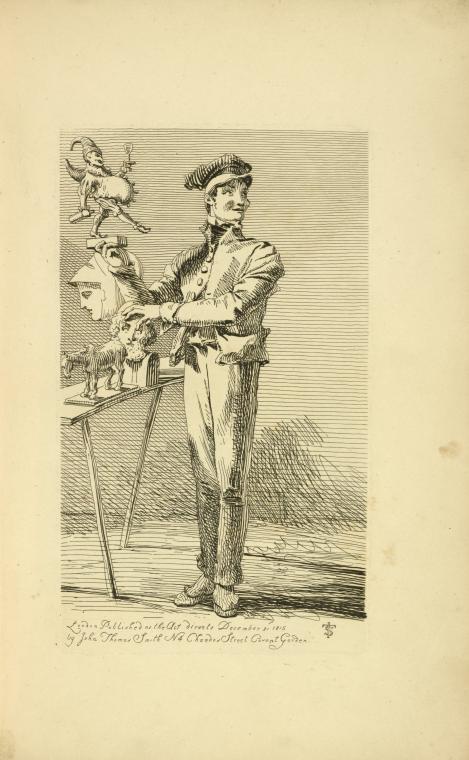
Italian street vendor, 1815 |
"... It appears that the first figurinai to emigrate from Barga did so at the beginning of the eighteenth century. At first they travelled to the main Italian cities; later in the century they ventured abroad, to France, Germany, and even England. They never emigrated on their own, but moved in groups of five to seven people, under the leadership of a master, who would be the most experienced in the trade, as well as knowing some European capitals. Often the other members of the team were young apprentices, aged from 12 to 15, or mere street vendors who wished to associate with those itinerant craftsmen. A formal agreement was struck between the master and the apprentices, who undertook to work for him for some three years. The apprentices were lodged and fed by their master, who also paid them a certain wage. If they brought back more than a certain agreed sum, they were entitled to a share of the returns in proportion to the number of pieces they had sold.
"These small teams left the Tuscan hills towards the end of winter or in early spring. The master was normally the 'moulder' (formatore); one apprentice was the 'cleaner' (sbavatore), who polished the images as they came off the mould; another apprentice was the 'painter' (colorista), who coloured them. The other apprentices and vendors did the perambulating side of the business, carrying the items either in large straw baskets or on boards balanced on their heads. The masters carried with them the tools necessary to make the statuettes: plaster, moulds and colours."
Bartholomew may have started as a vendor around 1805, at age 12. By age 25, when he married Louisa, he could have had a number of compagne (tours) under his belt, progressing during that time from child hawker to master, with his own set of molds and the skills to make more. He was one of the few (about 10%) who retired from itinerancy and took up residency in England.
|
Known children of Bartholomew & Louisa |
||
| Siderina | bapt. 23 Mar. 1819, Rye, Sussex, England | |
| Angeline | bapt. 20 Mar. 1822, Rye, Sussex, England | |
| John | b. ca. 1824, Wales | |
| George | b. June ca. 1828, Wrexham, Denbighshire, Wales | |
| Flora Louise | b. 22 June 1830, Italy | |
| Rebecca H. | b. 24 Jan. 1833, Florence, Italy | |
| Joseph C. | b. 19 Mar. 1837, Lucca, Tuscany, Italy | |
| Zippora Elizabeth | b. Dec 1841, Florence, Italy | |
| William | b. 6 Dec. 1847, Florence, Italy | |
By around 1824 the family had moved to Wales, probably Wrexham, a market town in Denbighshire where son George was born around 1828. By late 1828 they were in Liverpool, a growing city in Lancashire, England, about 25 miles north of Wrexham. An item in The London Gazette ("Published by Authority"), Friday, 31 Oct. 1828, tells of the trouble that beset Bartholomew that year. The London Gazette is the most important of several official journals of record of the British government, and a large part of this particular issue is devoted to the hearing of cases for the relief of insolvent debtors, such as Bartholomew: z4
"Bartholomew Menchine, formerly of Emblas-Street, Wrexham, in the County of Denbigh, and late of No. 29, Pit-Street, Liverpool, Lancashire, Straw-Hat-Manufacturer."
|
Arrival of prisoners at Lancaster Castle, 1827 |
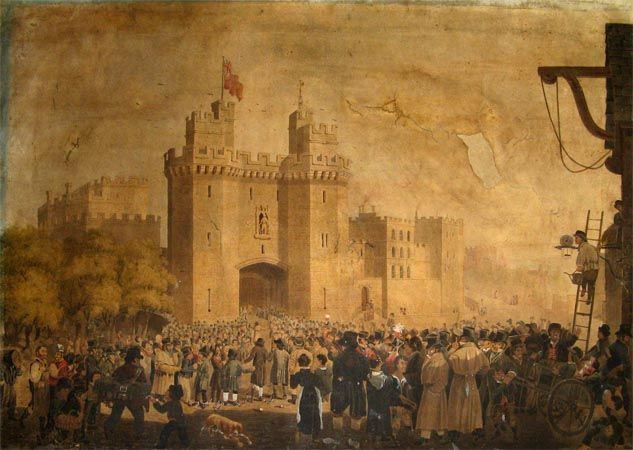
This item, a petition for release, was one in a long list of cases to be heard at the fall session of the Court for Relief of Insolvent Debtors. Bartholomew's case was to be heard on the third and last day (24 Nov. 1828) of a session at Lancaster Court-House, indicating that he was being held prisoner at Lancaster Castle Gaol, the largest debtors prison outside of London at this time. Bartholomew had perhaps suffered some calamity which rendered him unable to pay his debts, and was sent to Debtors Prison as the result of a suit filed by one or more creditors. He could have been held indefinitely if his creditors so wished. An interesting article featuring the story of a mid-19th C debtor confined to Lancaster tells us that conditions at Lancaster were not bad, compared to those at Marshalsea and other debtors prisons. "Tales of fairs, mock elections and concerts abound. Etchings, done by a man who was himself incarcerated in Lancaster Castle for debt, show well-appointed rooms, complete with servants, fires and what seems to be a plentiful supply of food and drink. ..." z5 This sounds too good to be completely true. It may have been true for those who could afford it, but you had to pay for special privileges, and it seems more likely that people like Bartholomew would have been more interested in repaying their debts, getting out of prison and returning to their families.
Bartholomew's petition was not successful, as we learn from an article in the Lancaster Gazette on 29 Nov. 1828: z6
"Bartholomew Menchine, late of Wrexham, in the county of Denbigh, was remanded for the period of two years, from the time of filing his petition, at the suit of some one or more of his creditors, for concealing his property, and diminishing the sum to be divided amongst them.—He was arrested in Liverpool, where he had taken his passage, and was on the eve of embarking on board a vessel, intending to decamp to Italy (his own country) taking with him a considerable sum of money, and leaving his English creditors to lament their folly in trusting an Italian."
In defense of Bartholomew (and in response to this bit of British bigotry), it can easily be argued that the British system was unjust. You were imprisoned until the debt was repaid to your creditors, but it was your family and friends who were expected to pay, not only the debt but also the charge for your accomodation in prison, since prisons were operated for private profit. With some 10,000 people imprisoned for debt each year, filling half the prisons with insolvent debtors, Bartholomew would certainly have been aware of his predicament and may have been trying to escape the injustice of it. The Debtors Act of 1869 put an end to almost all of the indefinite imprisonment for non-payment of debt. z7
Since daughter Flora was born around 1830 in Italy it appears that Bartholomew upon his release did not waste any time fleeing England with his family. In 1830, Siderina was 11 years old, Angeline 8, John about 6, and George about 2. We currently know little about the family while they were in Italy. Since son Joseph was born in Lucca in 1837, and Zeppora in Florence in 1841, they'd moved to Florence sometime in between. William was born in Florence in 1847.
It may have been that John, at age 17, followed in his father's footsteps and took a tour of his own as a figurinai in England. There was a Giovanni Menchini who was a member of a group of eight figure makers from Italy who arrived from France at the port of Dover on 9 April 1841. The master was a Giovanni Santi Pieri. They do not appear in the 1841 Census of Great Britain, officially dated 6 Jun 1841, and we know no more about them. z8
|
Italian image-makers, NYC, 1869 |
We believe we've found Bartholomew on a ship's passenger list in 1851. A Bartolimo Menckini, age 50, plaster worker, accompanied by a (daughter?), ("Cuetini"?), age 15, sailed on the Sardinian brig Radamisto from Leghorn (Livorno), Italy, arriving at New York City on 14 May 1851. Ten of the passengers were accomodated in the cabin while the rest rode steerage. Fifteen of the 35 passengers (including Cuetini) were plaster workers, 18 were image makers and two were cabinet makers. The "country to which they belong" was given as Sardinia for all, and they all intended to become inhabitants of the United States. The passengers were likely all from Lucca, actually. It may be that the ship's master, Andrea Bozzo, considered Lucca Sardinian at that time (Lucca officially became part of the Kingdom of Sardinia in 1860, for a year). It also may be that the passengers were a team, recruited to work on some project in or near New York City. And it could be that this indicates what Bartholomew had been doing in Italy for those past twenty years. It's also possible that "Cuetini" was Joseph C., who would have been 14 years old at this time. It may be that Cuetini was his middle name, a family surname (there are numerous present-day "Caetani"—that 'u' could be an 'a'), and that the captain either mistook him for a female or assumed Cuetini was a female name.
|
Straw hats, 1850 (Harper's Monthly) |
We have not found a passenger ship record including the rest of Bartholomew's family, but we suspect they all came in 1853. Bartholomew, figuremaker, first appeared in the NYC city directories in 1854, with both his business address (his studio) and his home address as 219 Sullivan street, about a block south of Washington Square. George also appeared in an NYC city directory (Rode's, as opposed to Trow's) that year, with the same address. In 1855, per the New York state census of that year, Bartholomew, plaster molder (age 63), Louisa (53), Joseph (15), Zeppora (12) and William (6) were living in Manhattan and had been there for two years. (Joseph, Zippora and William were actually 18, 13 and 7.) If Bartholomew had only been in NYC for two years at this time, then he must have lived (and worked) outside the city, perhaps in Newark, from 1851 to 1853, perhaps earning the ship fare for Louisa and the children. John and George were perhaps in California by June of 1855 (more below). Flora and Rebecca may have been in Newark, New Jersey, dealing in millinery. Siderina and Angeline stayed in Italy and never came to America, as far as we know. Bartholomew, figure maker, was still at 219 Sullivan street in the city directory in 1856; but the following year he was a bookbinder, at 248 Ninth street, less than half a mile east of 219 Sullivan. We've also read, in W. G. Menchine's Forty-Niner story, that Bartholomew, when he was in New York City, was an importer and dealer in straw braid, used in the manufacture of straw hats, and as there was no market for straw braid in NYC he was compelled to sell it in Baltimore, which was then the chief city in the manufacture and sale of straw hats.
|
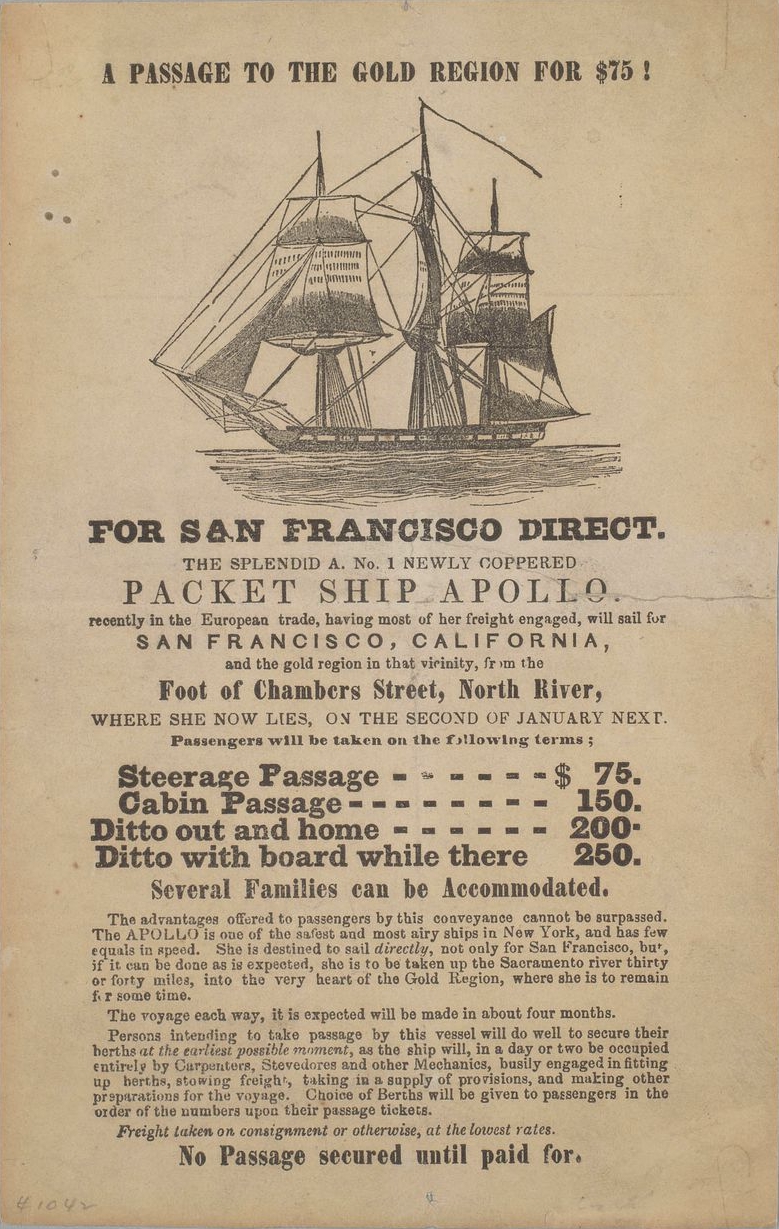
Passage to the Gold Region |
The California Gold Rush started in 1849 and the Menchine family did not miss out. We'll describe this part of the story in more detail since it's especially interesting. Our story is based on W. G.'s Forty-Niner story, which we've expanded a bit and adjusted parts to agree with what records we've found. Forty-Niner tells us that the three Menchine brothers went out to California by packet from New York via Cape Horn, in 1849 or 1850, when the "gold fever" was at its height. This could be true, but we're not so certain. It could be that they went out and back more than once each; but it seems more likely that each went out and came back once, with John and George leading the way around 1854 or 1855, and Joe later, in 1860. We say this, first because their names do not appear in the federal census of 1850 or the California state census of 1852; second because George, as we know, was in New York City early in 1854, since he got his name put in the city directory that year; and third because neither John nor George was with the family in NYC for the 1855 NY state census, but Joseph was, and had been there since 1853. We think Joseph was a "J. Menchine" who arrived in San Francicso in 1860, and was enumerated with George in June of that year in the federal census, in Calaveras County. We also know that Asher Adams, who they joined up with, was back by September of 1859, since he married Flora in NYC then. And John was back by June of 1860 since he was enumerated with Bartholomew in Newark in that year's federal census (and it was probably he who introduced Asher to Flora). So those are the constraints upon this story.
|
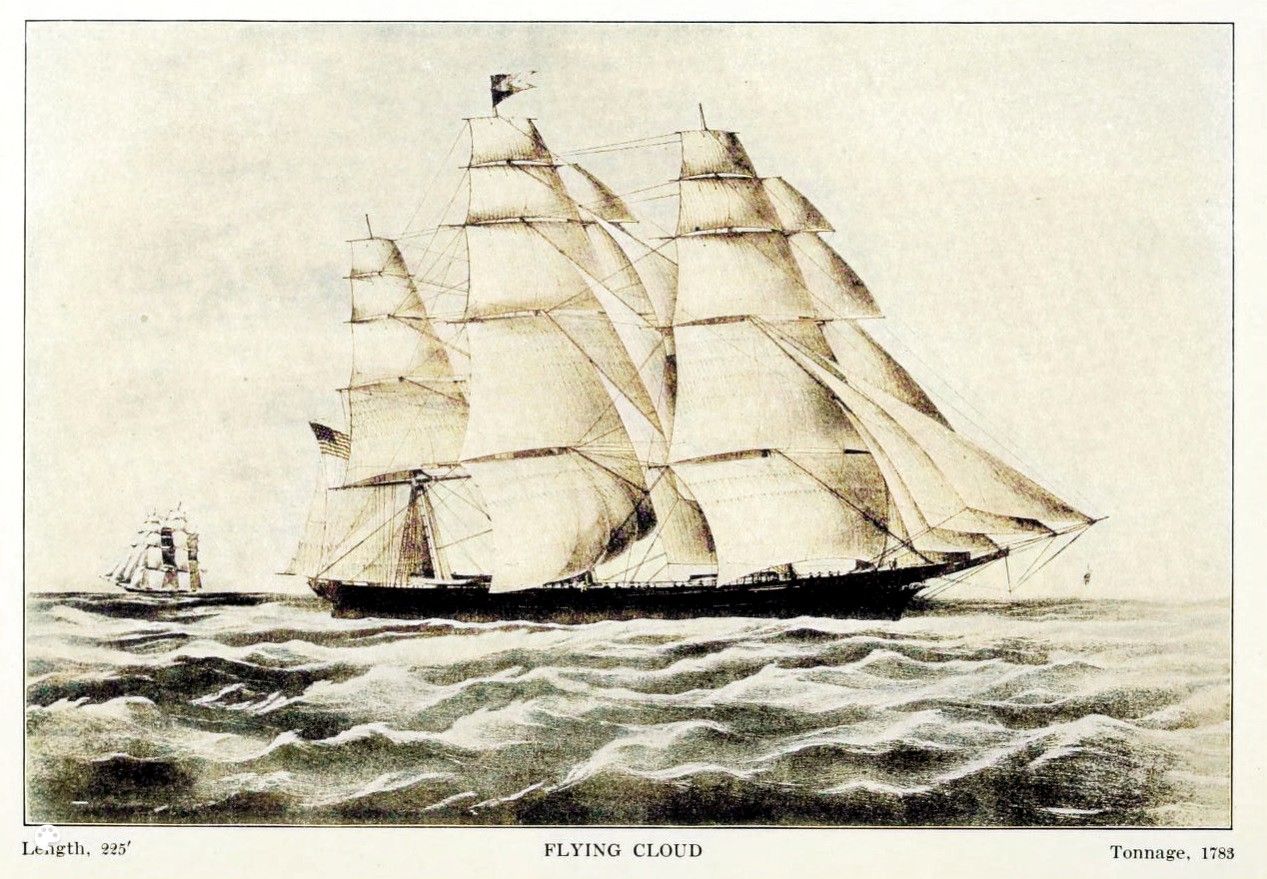
The Flying Cloud clipper ship |
After gold was discovered in California in 1848 thousands of fortune-seekers came from all over the country and all over the world, all of them called "49'ers," even those who came throughout the 1850's and into the early 1860's, when the hastle started to outweigh the gain. Some journeyed out or back by sea, and some by land. Either route had its dangers. Many journeyers died. John, at about age 30, and George, about 26, seem to have headed out to California either late in 1854 or early in 1855. Will tells us that his Aunt Angela related stories to him that she had heard from her father (W.G.), that W.G. in turn had heard from his father (George), including one about sailing to California — The ship was so close to the shore off the coast of South America at times that they could hear and see monkeys and birds in the trees and jungle along the shoreline.
|
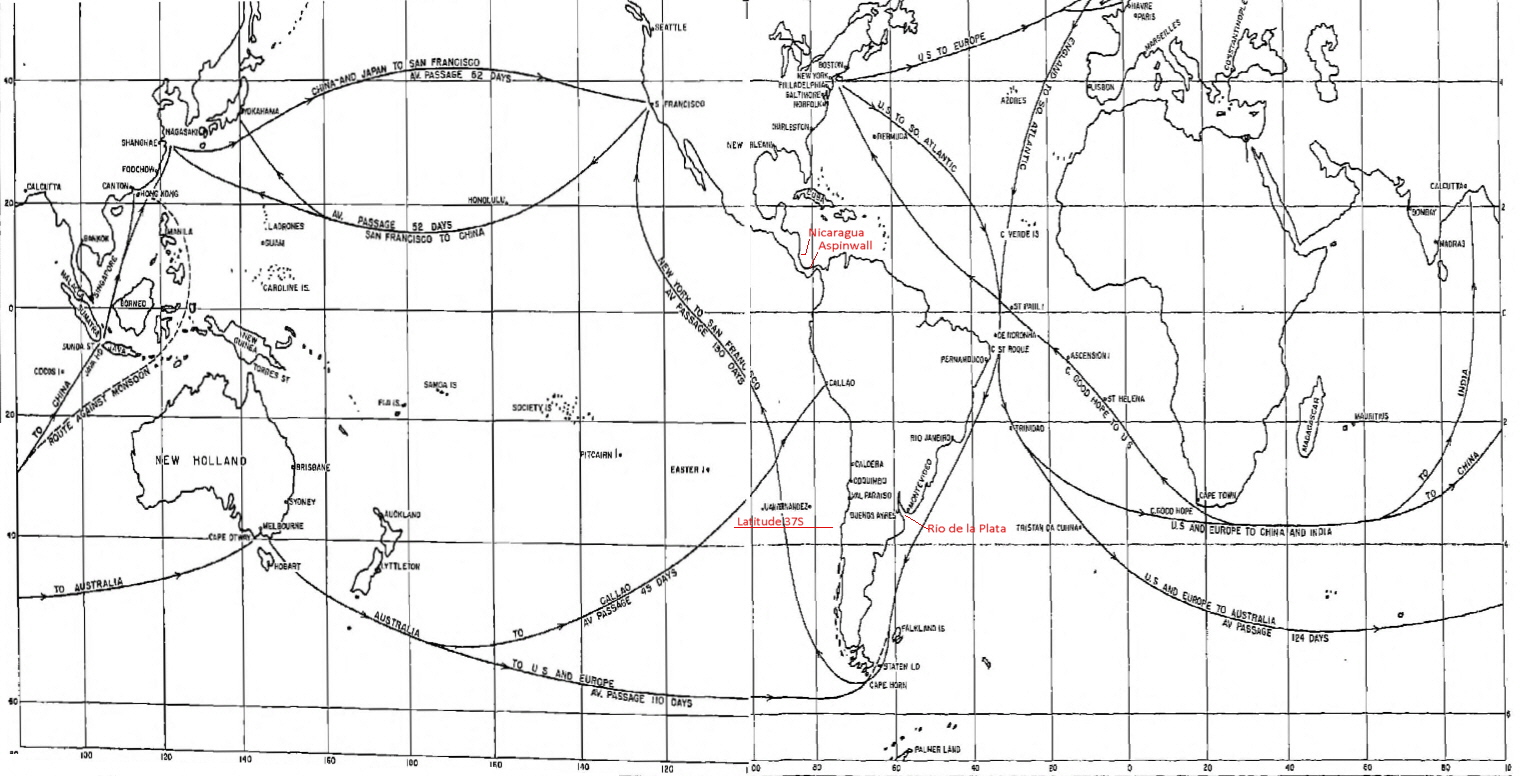
Clipper ship era |
We don't know which ship John and George took to San Francisco, so we'll pick one to serve as an example, one for which a ship log has survived (the San Francisco ship passenger lists were destroyed by fire in 1940). The Andalusia, a clipper packet ship (a ship built for speed, with regularly scheduled service) sailed from New York on 31 January 1852 and arrived at San Francisco on 24 June after sailing from NYC for 146 days (4.8 months), which included eleven days off San Francisco before finally able to make port. It had "Experienced a succession of SW and NW gales, from the River La Plata around the Horn and as far as 37S on the Pacific side of the Cape. Was off San Francisco port with light baffling winds from June 13, 1852 until making port. Anchored off North Beach in San Francisco harbor." The Rio de la Plata, at the southern border of Uruguay, is 1000 miles by sea from Cape Horn, and latitude 37 south is about 1400 miles further along the ship's course. The Andalusia carried mostly cargo, with about a dozen and a half passengers. z10 The cost of such a voyage (going by the image of a typical poster, above) was about $75 steerage, $150 cabin passage. This same Andalusia, Francis W. Wilson, Master, had previously carried many more passengers. Built in Baltimore, Maryland, in 1848, 772 tons, it brought 308 from Bremen, Germany, to Baltimore late that same year (1848), including 12 adults and 12 children rescued at sea from the ship Wakona. z11
|
San Francisco harbor, 1853 |
|
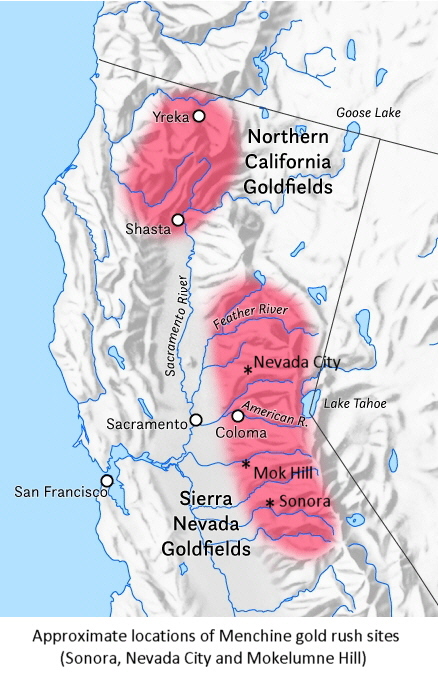
Gold Rush — Menchini sites |
Steamship travel to California was much more heavily pushed in the newspapers of the day. Much faster and considerably more expensive, it always involved transit across the isthmus of either Panama or Nicaragua by other means —railroad, riverboat, and mule across mountainous stretches. An 1853 itemized account kept by a woman from Vermont, traveling to San Francisco to be with her husband, lists the steamer ticket price as $305, which included meals. She also had to pay $8 railroad fare at Aspinwall (now Colón, Panama), $3.50 boat fare, $25 mule fare, and other assorted costs. But she made the entire trip, from Vermont to San Francisco, in less than a month (17 Jan to 16 Feb). z12 We assume the Menchine brothers went by sail because it was what they could afford at the time. The typical sailing route brought them close to the South American shore from "Pernamduco" to "Rio Janeiro" (see map above). The route on the Pacific side was all far out to sea. z9
|
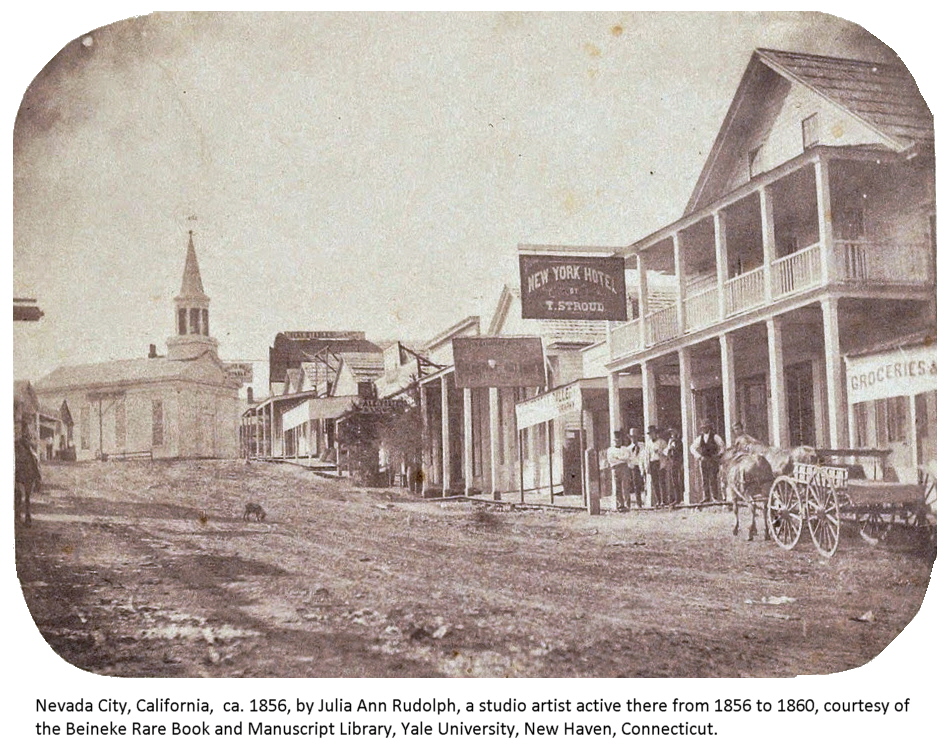
Nevada City ca. 1856 |
Will's father (W.G.'s son Conrad Menchine) was certain that the brothers spent time in the Nevada City area and along the route to the southern gold fields (Sonora, in Tuolumne County, was mentioned, and we know George and Joe were in Calaveras County in 1860). Will also mentioned Grass Valley, a couple miles southwest of Nevada City, as a possibility. It may be in Nevada City that they joined up with Asher Adams. There were a couple "A.J. Adams" (born around 1832 in Vermont) in Yuba County, next to Nevada County, at the time of the 1852 California state census. They could have been the same person, enumerated twice (it happens). Nevada City was the tamest of the places in which they dwelled. Sonora and Mokelumne Hill were rough and wild, more so in the early 1850's. Will has also told us that he has never heard of anything other than "panning and sluicing for gold" from his father—never any mention of mining companies or underground mines. Sluicing involves the use of a "sluice box" and natural water flow to speed up the panning process.
"Mok Hill's" population soared to 15,000 for a few of the gold rush years, forcing Calaveras County to restrict staked-out claims to 16 by 16 foot squares along the Mokulumne River and its tributaries. These claims still paid up to $20,000, which seems to be about the degree of success achieved by the Menchinis. W.G. wrote in Forty-Niner:
|
Panning for gold on the Mokelumne |
Records in my possession show that on October 22, 1857, Louisa Menchine, mother of George Menchine, deposited in the U.S. Assay Office, New York City, 232.06 ounces "California gold bullion" for which she received $4,572.34 in gold coins. A torn memorandum dated 1858 shows that George Menchine received from the U.S. Assay Office $11,149.54 for gold bullion deposited there, and other memoranda show various payments in gold coin made to George and John Menchine in the months of May and September 1860.
To get some idea of how successful they were — if we were to suppose that they made a total of $20,000 by 1860, that would be equivalent to about $750,000 today (2023). z13 Will has pointed out that if you go by the number of ounces and the value of gold then and now, $20,000 then is equivalent to about $1.5 million today.
|
The Overland Mail Coach |
Forty-Niner also tells us that "these hardy forty-niners returned to New York from the Golden West by way of the Overland Route." This certainly applies to George and Joseph's trip back east (since George was W.G.'s source of information), and perhaps to John and Asher's earlier trip, too. There were a number of "overland routes" at that time. One was the Butterfield Overland Mail stagecoach service, which operated from 1858 to 1861 on a southern route, and had the U.S. Mail contract from St. Louis to San Francisco, with a requirement that the mail delivery take no longer than 25 days. This required driving all day and all night, with the passengers eating and sleeping (or trying to sleep) while in transit. Waterman L. Ormsby, a correspondent for the New York Herald, remarked after his trip, "I now know what Hell is like. I've just had 24 days of it." The eastern end of this route was the western terminus of the Pacific Railroad (at Tipton, Missouri in 1858). The cost of that trip, $100 in 1858, was raised to $200 in January 1859 (equivalent to $6,800 in 2023). From there the Menchine brothers would have travelled by rail to NYC. z14
|
Bartholomew Menchine |
By early 1858 Bartholomew and Louisa had moved to Newark, NJ. Flora (probably with Rebecca) already had a millinery shop there. Louisa died there, on 19 June 1858, at age 55. Flora married Asher Adams in NYC in 1859, and Rebecca married Theodore Bull in Newark later that same year. A newspaper announcement of Theodore and Rebecca's marriage in Theodore's native home town of Towanda, PA, referred to Rebecca as "late of Paris, France." Could Rebecca and Flora have served millinery apprenticeships in Paris? Both husbands soon joined their wives in the millinery business. Not long after, Ziporra, and then George and "J." (either John or Joseph) also set up millinery shops. William and also Angeline's son Charles entered the millinery business in the 1870's. We wonder if all of Bartholomew and Louisa's children had been in the hat business since they were young, when Bartholomew was manufacturing straw hats in Wrexham and Liverpool, and perhaps in the Lucca and Florence years, too. Since they all established their own shops or stores it appears that artistry and competitiveness abounded.
Bartholomew, age 67, (no occupation given), and John, miner, age 36, were in Newark at the time of the 1860 federal census (so John was back from California by this time and Bartholomew appears to have retired).
Bartholomew died six years later, in Newark, on 29 May 1866 at age 73. Will Menchine tells us that, from what he understands, Bartholomew sponsored a number of his family and cousins in coming to the U.S., and helped them settle in Newark.
Afterword
We'll finish up with brief summaries of the stories of the children of Bartholomew and Louisa, from 1866 on. These, too, are based on records, which we include in the form of another records history, "Records history of the children of Bartholomew Menchine and Louisa Lilbourne."
The more detailed stories, in rough and data-heavy form, appear in those records histories.
Siderina Menchine married in Italy and remained there. We do not know anything about her life there except that she was still alive in 1900 (at age 81) as mentioned in Zippora's list of the heirs of Rebecca Bull, where her name was given as Sadarani Venucci, of Italy. We're assuming that Siderina and Sadarani were the same person.
Angeline Menchine married Alessandro Catalani, probably in Lucca, perhaps in the early 1840's. As with Siderina, we were not able to learn much about the family due to the inpenetrability of Italian records, very few of which from earlier than the 1850's are indexed. What we know is what has been passed down in the family. Judy is descended from Angeline and her son Charles Albert Catalani. We have more to say about Charles in a separate story. Charles, born, we believe, in Lucca, was the only one in the family to come to America. He came around 1870, to Newark, where he opened a millinery shop. The family probably moved from Lucca to Florence well before that time. Alessandro and Angeline also had two daughters, who never married, and lived in Florence. (A good guess at their occupations would be milliners, right? And, of course, Angeline and Siderina, too!) Charles wanted to bring his sisters to America, but they considered America "too barbaric." From the list of Rebecca's heirs we learn that Angeline died before 1900, and Charles and a daughter named Mary, of Florence, were listed as the heirs in her stead.
John Menchine, gentleman, of 61 Bank Street, Newark, was required to register for the Civil War draft in June of 1863. It is this record which tells us that he was born in Wales. He was listed in the 1868 Newark city directory as a merchant, with a business address of 190 Broad street (likewise for Joseph). We've heard (as passed down in the family) that he (or possibly Joseph or Will) returned to Florence, apparently around 1869, to study and sing opera. He married there—we do not know his wife's name—and never returned to the U.S. The list of heirs in Rebecca's 1900 probate record includes niece Louisa, of Florence, daughter of Rebecca's deceased brother John.
George Menchine, in October of 1865, married Ellen Graham, who was born in County Wicklow, Ireland. He and Ellen raised a family of three children: Grace (b. 1866), William (1870) and Louis (1872). A fourth, Mary Ellenora, died soon after birth in 1875. On his return from California he purchased property on Broad Street on which he built the largest department store in Newark, selling the property in 1870 for $85,000. He kept up a millinery business on Broad Street for nearly twenty years. Fluent in Italian, French, Spanish, and Portuguese, as well as several dialect Indian languages, he was often called upon to act as interpreter before the courts of New Jersey. In 1885 he moved his family to Washington, D.C., where he worked as a guide at the U.S. Capitol for eighteen years. Ellen died in 1889, at age 45. George died 18 Jan. 1904. An obituary in The Millinery Trade Review adds: "Veterans in the trade will remember him as a quiet, gentlemanly man, who was not a hard customer to sell to, for he knew what he wanted and was willing to pay the price, and could not be induced to take anything else." Another obituary mentions that he had two sisters and one brother still living (so it appears that Sadarani was still alive at age 85).
|
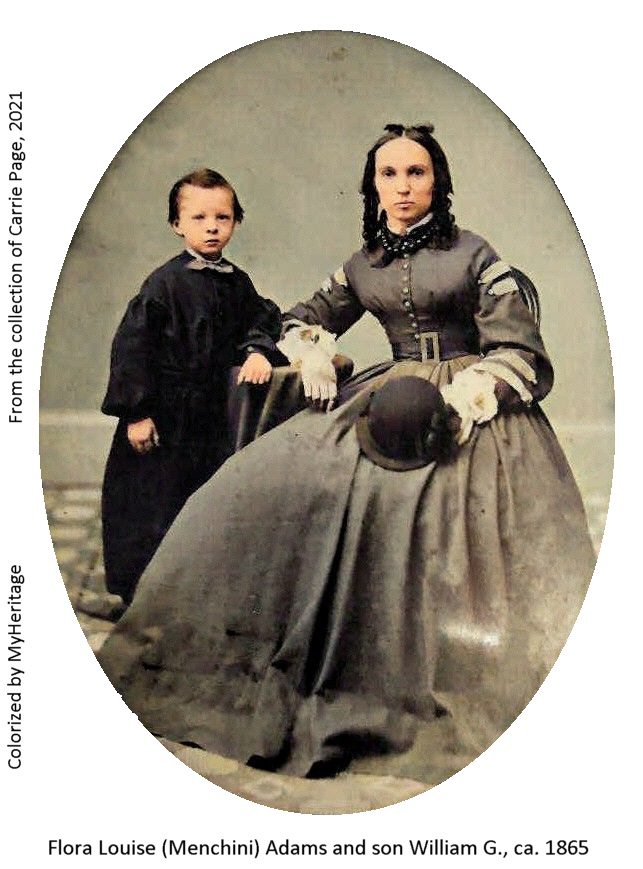
Flora (Menchini) Adams & |
Flora Louise Menchine first appeared in Newark city directories in 1856, as a milliner on Broad street, so she was in Newark by early that year, probably with Rebecca. She married Asher Adams (b. ~1832 in Vermont) in September of 1859, in NYC. (So Asher was back from California by this time.) We have not found Flora in the 1860 federal census, but we believe Asher was an A. J. Adams, listed as a 23-year-old tin peddler in the boarding house of a tin manufacturer in Troy, NY. In June of 1863, in his Civil War draft registration record, J. Asher Adams, 33, born in VT, was an unmarried [sic] tinworker in Newark. By June of 1865 Asher and Flora and their son, William G., born about 1861 in NY, were settled in Hudson, Columbia County, NY, on the Hudson River about 30 miles south of Albany, where they had established a millinery business. Flora's millinery shop in Hudson,
By 1870 Asher had opened a dry goods store there while Flora continued to run the millinery shop with the help of three women who were living with them. They remained there until about 1878, when they moved about 17 miles east to Hillsdale, NY, a couple miles from the Massachusetts line, where they had a 131 acre farm with 28 cattle, 75 sheep, etc., 25 acres of rye, an apple orchard, etc. Son William G. married Carrie ten Broeck around 1881. Their son Asher W. Adams died in Hillsdale in 1890. In 1897 Asher and Flora sold the farm and moved to Troy, NY, where Asher appears to have opened a drug store, in which William G. worked as a drug clerk. William G. died in 1901. And Flora died on 29 Oct. 1905, in Troy, at age 75 years 4 months and 7 days. She was buried in Hillsdale. Asher continued to live with his daughter-in-law, Carrie, and moved with her and granddaughters Ruth B. (a millinery saleslady) and Marietta to Los Angeles, CA by 1910. He died there on 14 Feb. 1916, at age 83.
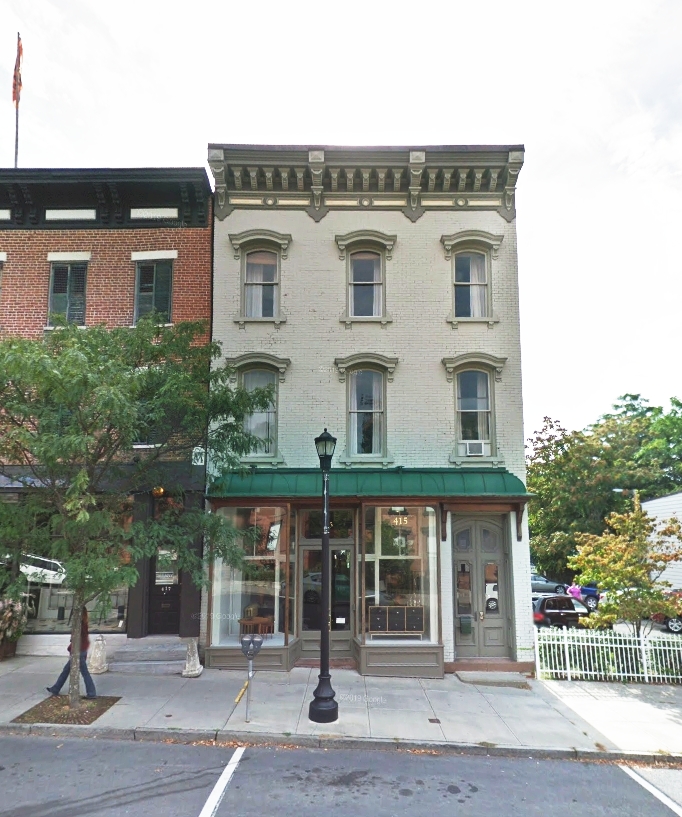
now (2015) The Hudson Milliner,
a boutique guesthouse & inn.
|
The Millinery Shop |
Rebecca H. Menchine probably was with Flora in Newark by early 1856. She married in Newark in April of 1859 Theodore L. Bull, a watchmaker, born in 1826, son of G. H. Bull of Towanda, Pennsylvania. Theodore then joined with her in the millinery business. Theodore died in September of 1874, in Newark, at age 48. They had no children. Zippora and her three young children moved in with Rebecca in the late 1870's after her husband, too, had died. Rebecca's passport application on 15 June 1875 tells us that she was born 24 Jan. 1833, in Florence; it also indicates that she traveled that year, perhaps to Florence, or Paris. In 1890 she traveled with Zippora's 17-year-old daughter Louise Bruno, returning home on the S.S. La Champagne from Le Havre, France on 8 September. In 1900 Rebecca (AKA Amanda, age 67), Zippora (58), their brother William (51), and Louisa (27) were all still milliners in Newark. Rebecca died in September of that year, in Newark, having lived there perhaps all of her 47 years in the U.S.
Joseph C. Menchini was a merchant with his brother John in the 1860's. Around the first of January, 1869 he sailed abroad, returning to Newark six months later. He left hardly any trail in U.S. records from then on; but it appears that later that year he went back to Florence with John, Ziporra and William, and returned to Newark ten years later. From his death record, which is all we have to go on after 1869, he died at Rebecca's house in Newark on 9 Oct. 1897, at age 60 years 6 months 20 days, (father b. Italy, mother b. England), married, and a resident of NJ for 17 years. We know nothing about his marriage, which may have taken place in Florence. He appears not to have had any children living in 1900 since he is not mentioned in Zippora's 1900 list of Rebecca's heirs. It is interesting to note that when he applied for a U.S. passport in December of 1869 Joseph declared his birthplace to be "Lucca, Tuscany;" while in seeking naturalized U.S. citizenship a month earlier he declared himself a native of Sardinia, which seems to have been common for the Lucchese of that era.
Zippora Elizabeth Menchine kept a millinery shop in Newark through the 1860's. She appears to have returned to Florence before 1870, perhaps with John, Joseph and William. She married Jerolomo Bruno, probably in Florence, around 1870, and had children Louise (b. 1873), Frank (1874) and Albert (1876), all born in Florence. Zippora brought her new family back to Newark in May of 1876. Jerolomo, who took the name Jerome in the U.S., died not long after that, probably in Newark, since Zippora is listed as a widow in the 1880 federal census. Zippora and her children lived with Rebecca in Newark until Rebecca died, in 1900. Zippora administered Rebecca's estate. She herself died in 1903.
William Menchini (who stuck with "Menchini" his whole life) was born 6 Dec. 1847 in Florence, according to his 1869 U.S. passort application. Like John, Zippora and Joseph, he did not appear in the 1870 U.S. Census, so it could be that they all went back to Florence together. By early 1875, though, he had returned to the U.S. He made his first appearance in the Newark city directories that year, as a milliner, living with Rebecca, whose husband had died the year before. He continuing living with Rebecca up to 1881, by which time Ziporra too had moved in. In October of 1876, at the Boyertown-Ebenezer Methodist Episcopal Church in Philadelphia, PA, William, age 29, married Emma Tice, age 18, of Hudson, NY, whom he must have met while visiting Flora and family. Their first and only child, Richard, was born 19 Jan. 1879. They were living in Newark in 1880, both of them working as milliners; but they divorced some time before 1885, by which time Emma had reverted to her maiden name and son Richard, apparently, had died. William lived mostly with Rebecca and Zippora, working as a milliner salesman, until they died. In 1905 he was living with Asher and Flora in Troy, NY, working in real estate. From 1910 to April of 1920, when he died, William lived with Zippora's daughter Louise Woodworth and her husband in Bloomfield, NJ, a few miles north of Newark.
This last story is not that of another of the children, but of an ancestor who died just a few years ago.
|
Ron Menchine (1934-2010) |
Albert Ronald ("Ron") Menchine, a great-grandson of George Menchine, was the radio voice of the Washington Senators from 1969 (when Ted Williams arrived as manager) to 1971 (when owner Robert Short moved the team to San Antonio, Texas). Ron broadcast the Senators' last game, on 30 Sep. 1971 at Robert F. Kennedy Stadium against the New York Yankees, not in his usual ebullient manner, but in a monotone to suit his dark mood, lambasting Short repeatedly. His final soliloquy is famous. (See a YouTube video of a Ron Menchine tribute at Nationals Park on 28 Sept. 2010.) He also was an avid and well-respected baseball postcard collector, author of a book called A Picture Postcard History of Baseball, published in 1997. After the Senators left he helped to bring baseball back to Washington. He also acted in two movies: "The Seduction of Joe Tynan" (as Senator Aikers), and "All the President's Men" (as Post Librarian).
References:
z1. The one record which gives Wales as the birthplace of Louisa is son George Menchine's 1900 federal census record.
z2. Here are some of the items Judy found, on "image maker":
a. A good online paper on the subject: "Italian Image Makers in France, England, and the United States," Paola A. Sensi-Isolani, Saint Mary's College of California.
b. Figuristi di Gesso (Makers of Plaster Figures), by G. E. Fazzi, 1999.
c. A Migratory "Flight" — The Plaster Figures of the Serchio Valley, by Jenny M. Want.
d. A YouTube video tour of the G. Lera Plaster Figurines and Emigration Civic Museum, in Coreglia Antelminelli, a hillside town in Tuscany. Or, take a virtual tour of the same, on your own, courtesy of the Union of Municipalities of the Middle Serchio Valley. (Try right-clicking in the title area and opting for "Translate to English".)
z3. From Italian Immigrants in Nineteenth-Century Britain: Realities and images, by Lucio Sponza (Leicester University Press, 1988), p. 76 (based on A. Cavagnari, Del diritti spettanti alle Provinc Parmensi sui beni già patrimoniali dello stato (Parma, 1861), 12.).
z4. The [London] Gazette, Friday, 31 Oct. 1828, issue 18519, p. 1996, col. 1,
link (go to p. 1996), image of item.
z5. Lancaster Castle, History / People and Stories / "Steven Cropper".
z6. The Lancaster Gazette 29 Nov 1828, Sat, p. 3, col. 5; Newspapers.com link, image.
z7. "In debt and incarcerated: the tyranny of debtors' prisons," by Andy Wood, The [London] Gazette, 13 Dec. 2016, link.
z8. HO 2 Home Office: Aliens Act 1836: Certificates of Arrival of Aliens; Piece 89-1841: Dover Nos 1-1416; Ancestry.com "England, Alien Arrivals, 1810-1811, 1826-1869" (link).
z9. Greyhounds of the Sea, The Story of The American Clipper Ship, by Carl C. Cutler, 1930, pub. by The United States Naval Institute. The
frontispiece map is labeled "Clipper Ship Sailing Tracks, compiled from various editions of Maury's Sailing Directions. The Andalusia is mentioned on p. 391 (Internet Archive).
z10. San Francisco Ship Passenger Lists, Volume IV, June 17 1852 to January 6, 1853 (A Volume of the SHIP'N RAIL Series), by Louis J. Rasmussen, Colma, Cal., 1970. See the Introduction, starting on p. vi, and
here for the Andalusia log (FamilySearch).
z11. Immigrant Ships Transcribers Guild / Ships Andalusia and Wakona, transcribed from NARA film series M255, roll 6, by Nancy S. Mehaffie, and contributed to the Guild, link.
z12. "When Money Was Necessary to Make Dreams Come True: The Cost of the Trip from Vermont to California via Panama" by Lynn A. Bonfield, Vermont History, vol. 76, no. 2 (Summer/Fall 2008): 130-148, Vermont Historical Society.
z13. Ian Webster's inflation calculator.
z14. See Wikipedia: Butterland Overland Mail (2023).
Images:
Bartholomew Menchini (1793-1866): From the collection of Michael Menchin, descendant of George, 2016, colorized by MyHeritage.
Italy, 1851: Map of Italy, postal, itinerary and administrative for travelers and students, by Gio. Battista Bordiga, Milan, 1851; Library of Congress link; annotated by Conrad Terrill, 2023.
Italian street vendor, 1815, by John Thomas Smith: "Street vendor with classical sculptural heads and figurines of a horse and an elf," Digital Collections of the New York Public Library, link.
Arrival of prisoners at Lancaster Castle, 1827: unknown author. Wikipedia "Lancaster Castle", Wikimedia image link.
Italian image-makers, NYC, 1869: Harper's Weekly, 27 Feb 1869, p. 133, Internet Archive link, colorized by MyHeritage.
Straw hats, 1850: Harper's New Monthly Magazine, vol. 1 (June to November 1850), p. 143. Internet Archive link, colorized by MyHeritage.
Passage to the Gold Region: Poster, ca. 1849, contributed by UC Berkeley, Bancroft Library to the Online Archive of California.
The Flying Cloud clipper ship: Artist: "Some ships of the clipper era, State Street Trust Company, Boston MA," Wikimedia
link.
Clipper ship era sea route map (see reference z9).
San Francisco harbor, 1853: A composite of images from OpenSFHistory, June 2017, "Yerba Buena Cove 1853: A Closer Look," by Woody LaBounty. The original daguerrotypes (copied several times since) were taken by photographer William Shew from Rincon Hill in 1853. Colorized by MyHeritage.
Gold Rush — Menchini sites: Wikimedia "File:CaliforniaGoldRush.png" by Hans van der Maarl, 2015; link, annotated by Conrad Terrill, 2023.
Nevada City ca. 1856, by Julia Ann Rudolph, a studio photographer active in Nevada City from 1856 to 1860. Original photograph is in the Beineke Rare Book and Manuscript Library, Yale University, New Haven, Connecticut Wikimedia link.
Panning for gold on the Mokelumne: Harper's New Monthly Magazine, Vol. XX No. CXIX (20: 19) Apr 1860, "Panning," on the Mokelumne, p. 600, Internet Archive link, colorized by MyHeritage.
The Overland Mail Coach: illustration from Arizona, As It Is, the Coming Country, by Hiram C. Hodge (1877), artist unknown, Wikimedia
link.
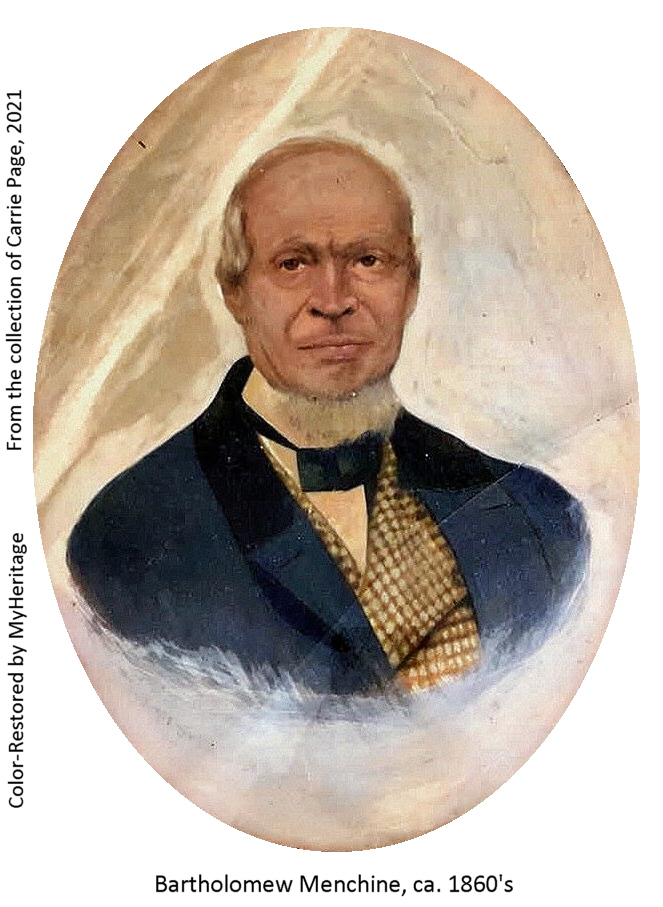
Bartholomew Menchine (in the early 1860's): From the collection of Carrie Page, descendant of Flora, 2021, colorized by MyHeritage.
Flora (Menchini) Adams & son William G., ca. 1865: From the collection of Carrie Page, descendant of Flora, 2021, colorized by MyHeritage.
Flora's millinery shop ... (and Asher's dry goods store), a Google Maps Street View image from 2015, Hudson, Columbia Co., NY, 415 Warren Street. The address of this duplex was 217 & 219 Warren when Flora and Asher lived in it, from 1866 to 1878. The Hudson Milliner guesthouse & inn, and art salon in the back, has been there from 2013 to the present (2023).
The Millinery Shop / by Edgar Degas, ca. 1879-1886: Wikimedia "image link".
Ron Menchine (1934-2010): IMDb, colorized by MyHeritage.
Acknowledgements:
William George ("Will") Menchine, great-grandson of George Menchine, has contributed much to this story in the form of family stories passed down to him, including the Forty-Niner story mentioned above. He also shared with us the image of Bartholomew at the top, which had been passed down in his father's family.
Thomas Hooker has shared with us his report of a ton of research he has done on the Menchine family for his sons—a report which brings their branch of the family up to the present. For those of you with subscriptions to Ancestry.com, here's a link to his public member tree: "Menchine Family Tree." Tom shared with us the second image of Bartholomew Menchine, along with that of Flora Menchine Adams and son William G., which had been shared to him by Carrie Page, a descendant of Flora's.
If you know of other records, stories, pictures, etc., pertaining to the Bartholomew and Louisa Menchine story, please let us know (contact Conrad at cwterrill@comcast.net). We'll be happy to work with you.
 p143 - sepia.jpg)