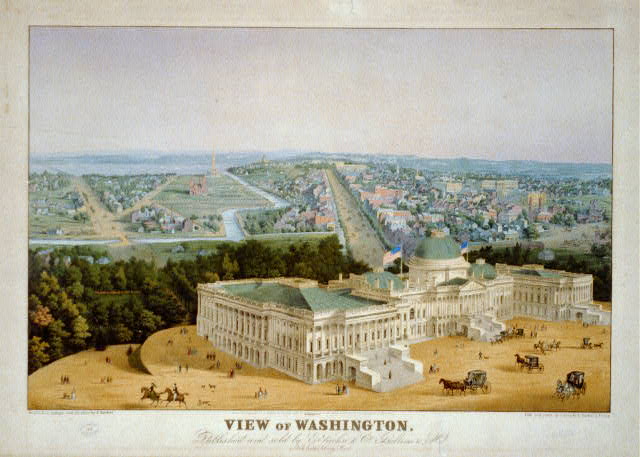
Birds-eye view of Washington, D.C., E. Sachse & Co., c1852 1
| Grindell Project |
An updated version of the story of Sarah Ann Grindall
last edited by Conrad W. Terrill, 26 August 2023
Note: Click on a picture to open a high-resolution version in a new window.
In 1998, in A History of the George and Ellen Grindell Family of Cumberland, Maryland, I included what little we knew at that time of George's parentage, and of his ancestry. We can now, in these days of online access to a wealth of records, fill in many details concerning his grandfather, William Grindall (~1789-~1860), and William's family, including Sarah Ann Grindall, George's mother. This story concerns just Sarah Ann.
The evidence we had previously that Sarah A. was George's mother was an 1850 U.S. Census record for the William Grindall family of Baltimore, listing among others Sarah A., age 27, and George W., 4. Also, we had a draft of a letter written in 1898 by Ellen (Shearan) Grindell, George's wife, to "Mrs. Sarha A. Purcell," informing her of the death of her son. Although we haven't yet learned much of Sarah's life before 1850, we have learned a lot from thereafter. From an 1879 marriage certificate we have learned (from Sarah herself) that she was born in St. Mary's County, and that her maiden name was Grandell (we assume the minister misunderstood, and that this should be "Grindell"—there were no "Grandell"'s in St. Mary's County from 1790 to 1830, per the federal census returns). This basically certifies that Sarah was a daughter of William and Mary (Lathrom) Grindall, as opposed to a daughter-in-law. William and Mary moved their family from St. Mary's County to Baltimore around 1825, at which time Sarah was around two years old. We also know, again from Sarah herself (with help from her daughter), that Sarah was not married when George W. was born.
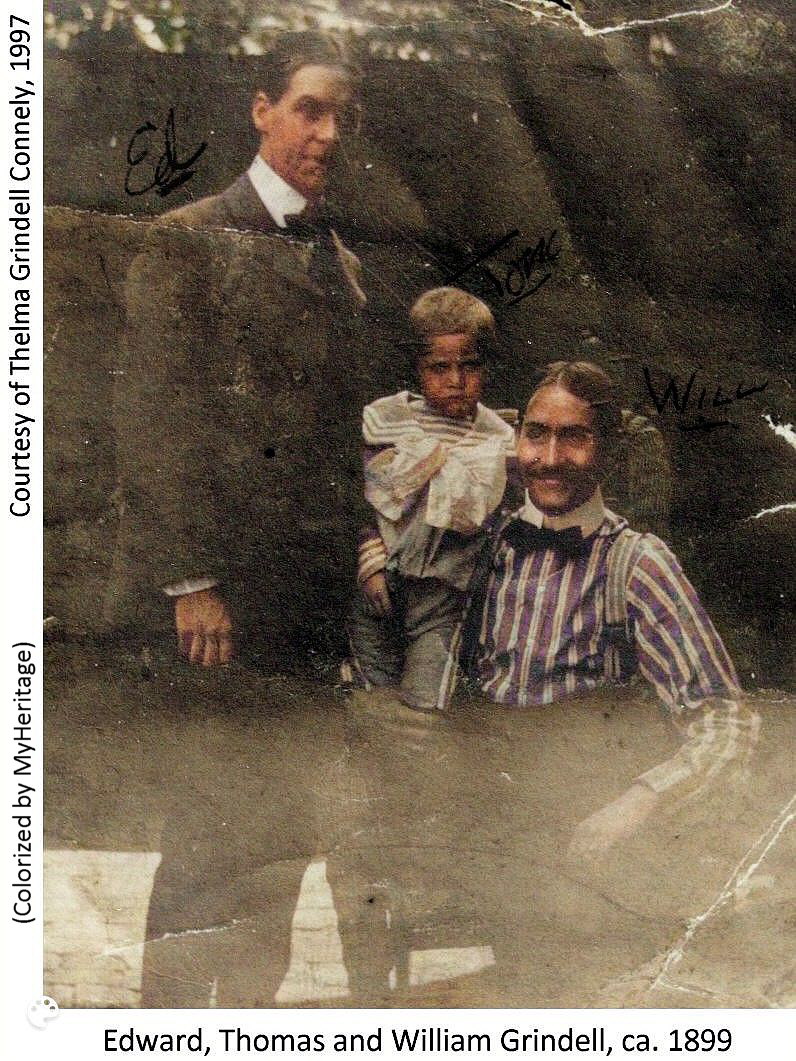
Our copy of the 1898 draft tells us that one of Ellen Grindell's sons, probably Will, age 23 at that time, or else Edward, 21, visited Sarah to inform her of her son George's death, and found that Sarah was "inclined to disown [George, her] own son." Ellen soon afterwards visited "George's cousin," Mrs. Laura Hayes and "learned that you [Sarah] spoke falsely to hide your own misdoings and to blemish your son's good name." The letter also tells us that Sarah's daughter asked Ellen's son if George had married under the name Grindell, to which Ellen replied, in the letter, "(yes!) he did and he was reared up to believe that Grindel[l] was his name and if it is not his name you are the one who can correct the mistake is to blame." We're left to wonder why Sarah would have seemed to disown her son, and why Sarah's daughter asked about the name. In 1998 we did not know who "Mrs. Laura Hayes" was, nor who Sarah's daughter was; but we know now. Let's start this new story from the early 1850's, though.
|
|
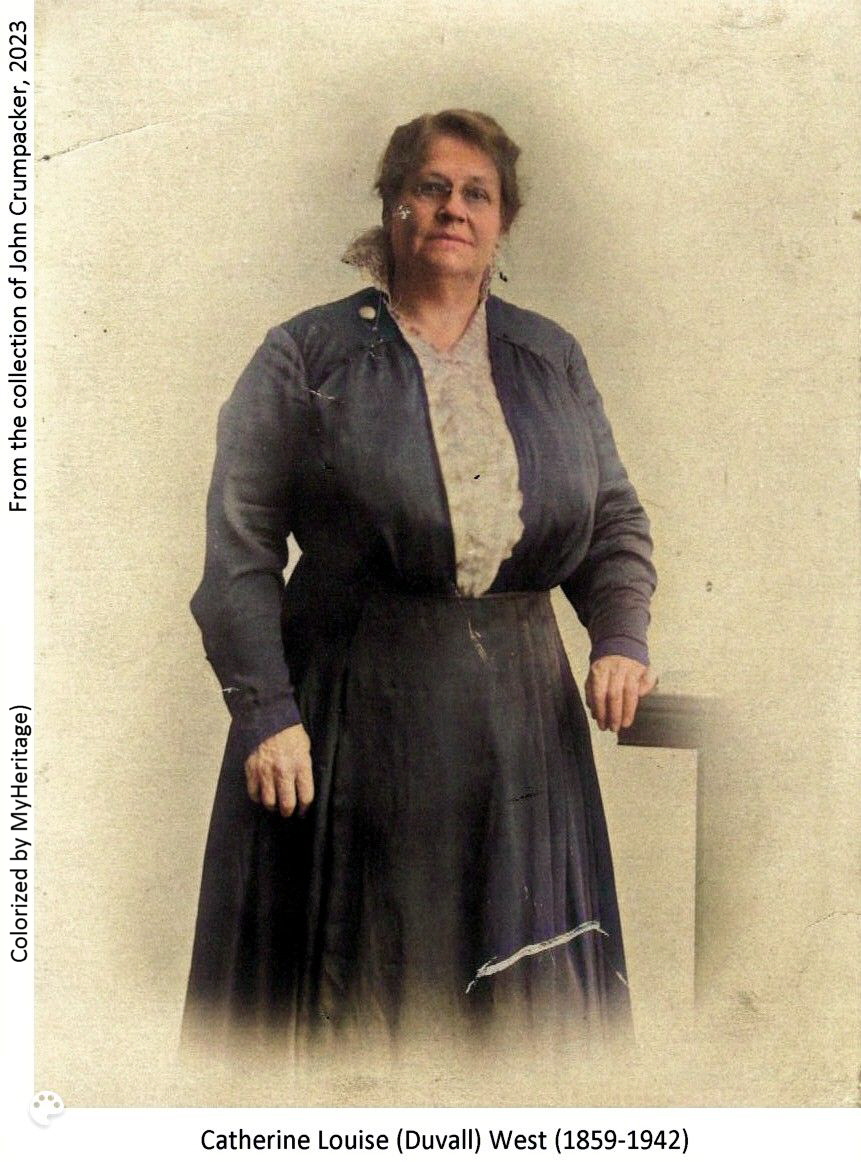
Sarah A. Grindall's first marriage was to William E. Duvall on May 20th, 1852, conducted by W. B. Edward, Pastor of the Methodist Episcopal Church in Alexandria, Virginia. George would have been about six years old at this time, and may have then taken on the surname Duvall. William and Sarah's first child (and only child, as far as we know) was born Dec. 19th, 1859—Catherine Louise Duvall. George was then about 13. Catharine ("Kate") will turn out to be Sarah's daughter who asked in 1898 if George had married under the name Grindell. George, at about age 14, is not listed with the family in the 1860 federal census. Nor can we find him anywhere else. The Duvall family that year (1860) consisted of William E., 41, laborer, born in Virginia; Sarah, 31, born in Maryland; and daughter Catherine L., born in D.C. and five months old as of June 1st 1860, the official date of the census. William may have been a William E. Duvall, boilermaker, who showed up in the Washington D.C. (District of Columbia) city directories in 1867 and 1868, although a William Duvall (no 'E.'), boilermaker, showed up once more in 1871, by which time Sarah's William E. Duvall was a grocer, according to the 1870 federal census. Louisa (Kate), 10, was in school at that time.
Sometime that year (1870) Sarah filed police charges against William. The case was brought to court on 29 September, with the newly appointed and first D.C. Police Court Judge, William B. Snell, presiding. The proceedings were strange enough to make the pages of the Evening Star that day:
| A SAD CASE. | ||
| William Duvall, charged with committing an assault and battery on Sarah Duvall, his wife. The testimony showed the assault to be an aggrivated [sic] one. The prosecuting witness was present to give testimony, and while waiting in the witness-room was seized with a violent fit, and it was thought at one time that she would not recover. This was succeeded with others, and the woman had seven spasms before she was admitted to the court-room. On entering she was very weak, and said she did not want to prosecute the case—that he was not guilty. She persisted in this assertion, and the Court dismissed the case. |
|
|
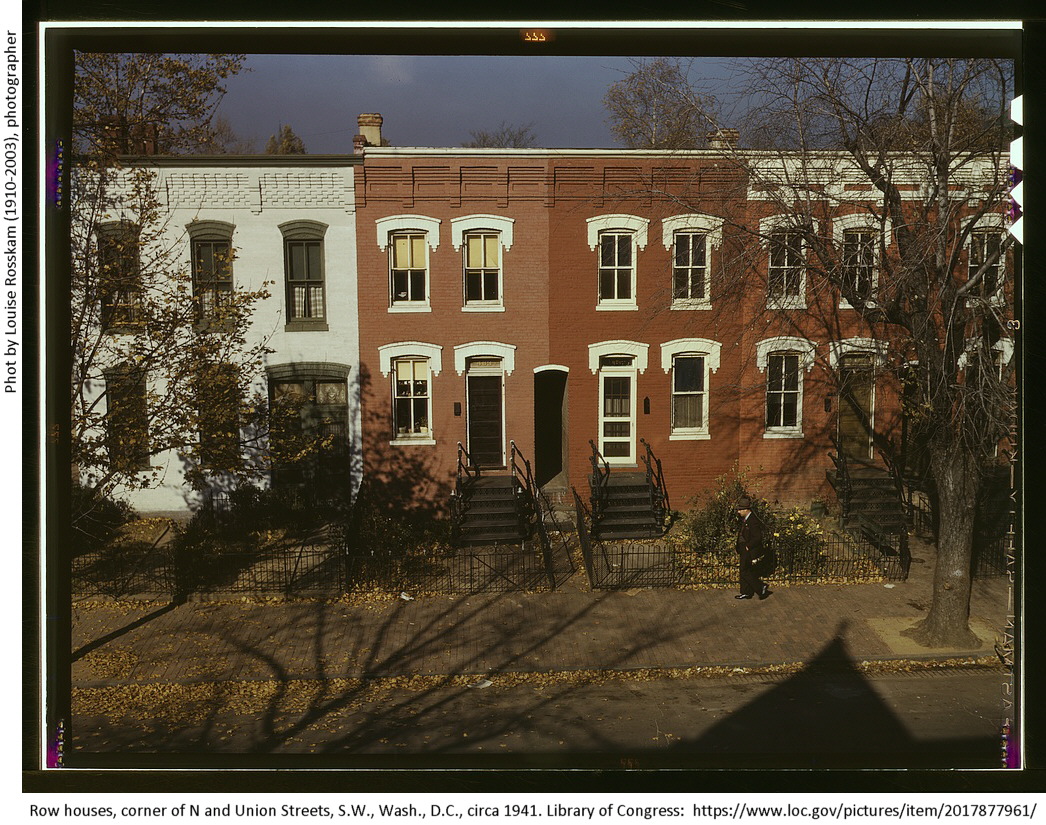
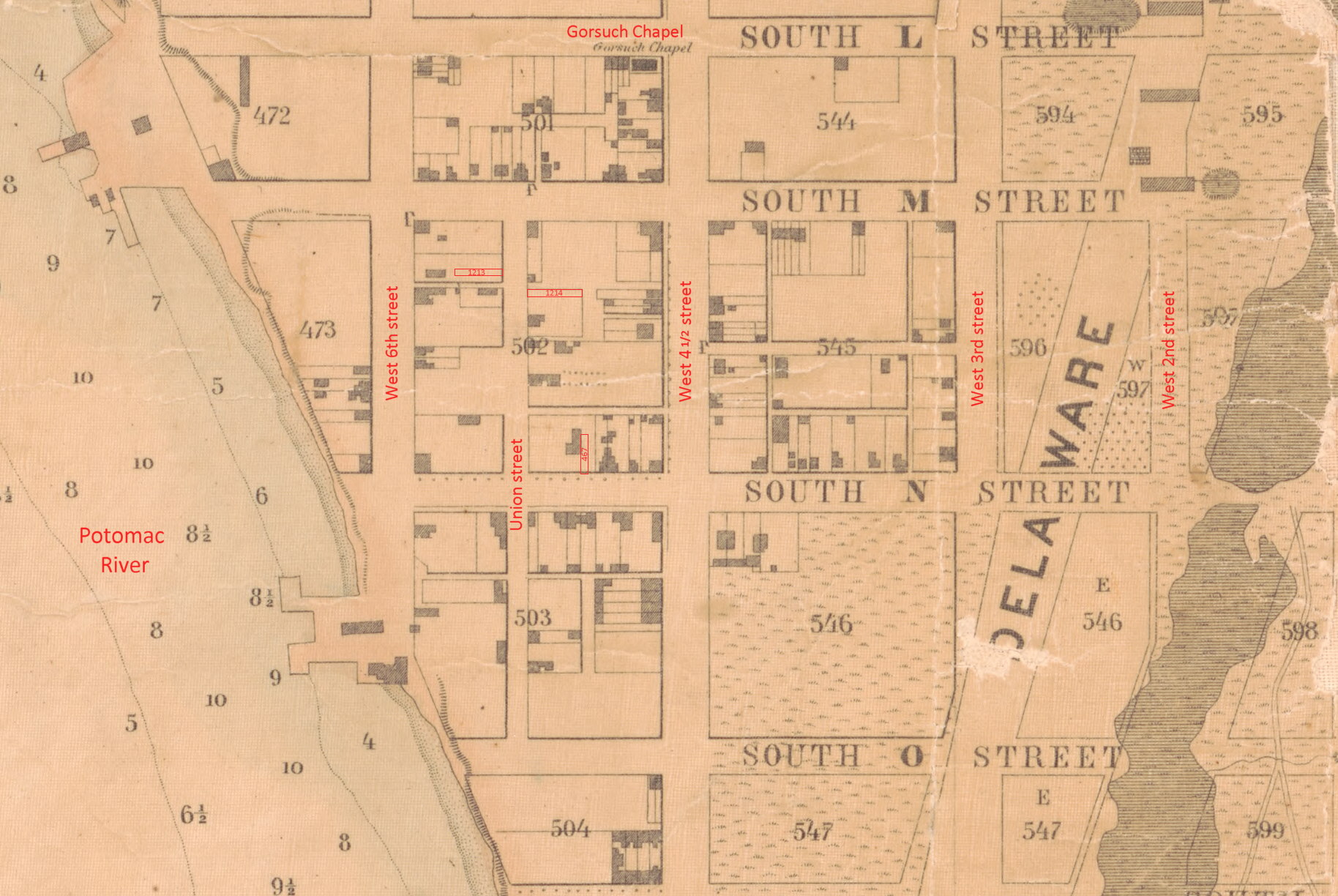
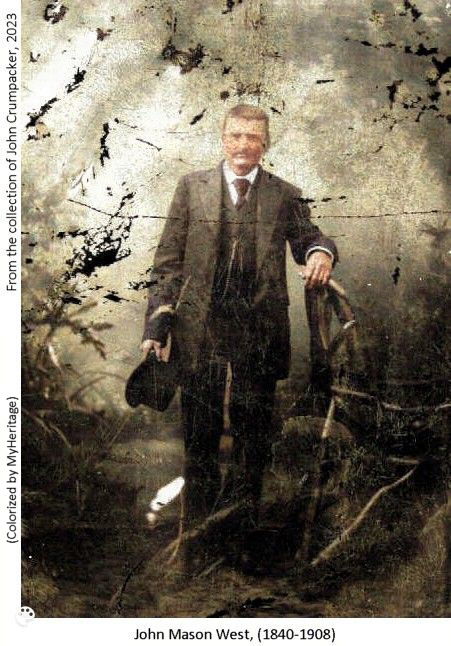
On September 18th, 1873, nearing age 15, Kate Duvall married John ("Jack") Mason West, 23, a horse and cattle dealer, whereupon Jack moved in with Sarah and Kate. William may have been dead by then. He seems to have died that year, since "Sarah Duvall, widow of William, grocer," started showing up in the Washington city directories in 1874. We haven't yet been able to find any record of William's death. Sarah's address varied from year to year until 1877, when it stayed nearly fixed at 1214 Union Street SW (southwest—Washington is divided into quadrants) for three years. She was listed as "widow William, grocer," all those years; so it may have been that she ran the grocery store after William died. It would have been a store at a nearby corner (the stores around there seem to have been at block corners). Kate and Jack and family (six children born between 1876 and 1893) were with her for all but eleven of Sarah's remaining years.
George Grindell, at age about 28, married Ellen Shearan, 17, on June 21st, 1874, in Cumberland, Maryland. He gave his father's name as William Grindle, as recorded in the St. Patrick's Catholic Church marriage record: "Georgium Grindle ex loco Cumbria filium Gulielmi Grindle" (George Grindle of Cumberland, son of William Grindle). It seems likely that George simply came up with a name when the priest at St. Patrick's asked for one, giving that of his grandfather, or of his uncle William Lewis Grindall.
Sarah Ann, 46 (actually about 52), married a second time on November 25th, 1875, to William Roller, 54, an engineer, at the Westminster Presbyterian Church's "Manse" (the clergy house inhabited by the minister, at 638 F street SW). We know little about this short-lived second marriage, and would know nothing at all if not for the John Purcell Civil War Pension file, which listed Sarah's marriages in an affidavit in support of a widow's pension in 1892. William Roller died of acute pneumonia a year after the marriage, on December 31st, 1876, at the Washington Asylum, and was buried in their "Potter's Field" (as was William Duvall, according to the pension file). The Asylum, popularly known as the "almshouse" or "poorhouse," was a few blocks northeast of Congressional Cemetery, on the then eastern edge of D.C., just south of where the DC Armory is today. This was a place where criminals, debtors, vagrants and the diseased were taken, and where the destitute, and elderly persons without means of support, could seek refuge. Living conditions were Spartan—dormitory rooms were unheated. 2
|
|
Sarah Ann married once more on June 26th, 1879. She, age 47 (actually ~56), and John Fleet Purcell, age 50 (actually ~57), an engineer, were married by Minister Jesse C. Starr at Gorsuch Methodist Episcopal Chapel, 456 L st. SW, D.C. One record of this marriage gives her name as "Sarah A. Duvall," while another gives it as "Sarah Grandell." That second record, a marriage certificate, is the one which informs us that Sarah was born in St. Mary's County. It also informs us that this was John's sixth marriage and Sarah's third. John was born in Northumberland County, Virginia, around 1822, give or take. John had been living, in 1879, at 410 13½ street SW, and Sarah moved in with him, while Jack and Kate stayed at 1214 Union street.
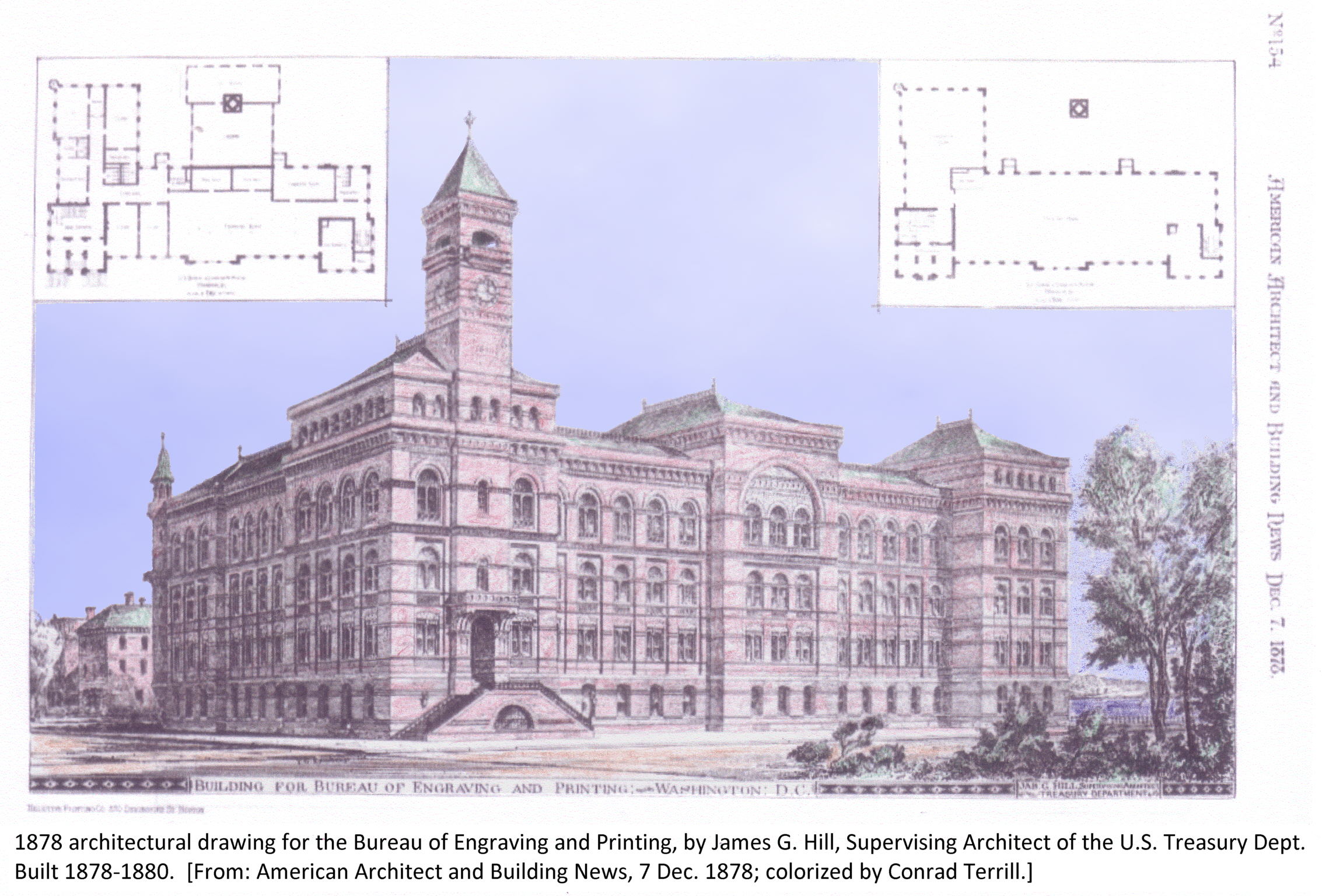
John Purcell's occupation was given as laborer in 1850, machinist in 1860, and consistently as engineer from 1864 on, in federal census returns and D.C. city directories. In the 1868 city directory there was listed a John Purcell, "Cur Bur, Potomac, Gtn." This was very likely our John F., and informs us that he was at that time working at the National Currency Bureau, in the Treasury Building, next to the White House, to the east, while residing on Potomac street in Georgetown, about a mile away. It might be that he had just landed the job there that year, considering that his occupation was given as "Cur Bur" instead of "engineer." The U.S. paper currency system started in 1863. The bureau in charge of printing currency was known by various names at the start: "Printing Bureau," "Small Note Bureau" and "First Division, National Currency Bureau;" and from 1869 to the present as the Bureau of Engraving and Printing. 4
In 1867 or 1868, a year or two before John married Sarah, he was employed at the Congressional Hotel, kept by William Sanderson, and was standing on a ladder fixing a union to the steam pipe in the kitchen when the ladder slipped out from under him and he fell about fifteen feet, landing on his hip and back on top of the ladder. He was confined to bed for several weeks, and suffered from that injury the rest of his life.
In the 1870 census John's occupation was given as "civil engineer." John was actually what was called a "steam engineer," one who operated or tended stationary steam engines, boilers, and auxiliary equipment such as pumps to provide power or maintain heat for buildings. The "civil" part of "civil engineer" perhaps indicated that he worked for the federal government that year, in civil, as opposed to miltary, service. He was not what we consider a civil engineer to be today. John could not read or write (and neither could Sarah), but this would not have been a job requirement for a steam engineer.
|
|
The Bureau of Engraving and Printing moved to a magnificent new building in 1880, on the corner of 14th and B streets SW. John and Sarah, along with John's son (or possibly nephew) John J. Purcell and his wife Betty, were living at 410 13½ street SW, close to that building (and possibly working there), in 1880 and 1881. John was listed in the city directories as an engineer in 1880 and a fireman in 1881, and Betty was a clerk in the Treasury Department. This was one of only two years John's occupation was given as fireman, a step down from engineer since a fireman was one who stoked the fire heating the boiler in a steam engine.
By 1882 John and Sarah were again living with Jack and Kate, now at 1213 Union street, where they stayed a couple years before moving to 303 7th street NW, halfway between the White House and the Capitol, where they remained until John died, on January 5th, 1892, of "La Grippe" (influenza). John remained an engineer to the year he died.
|
|
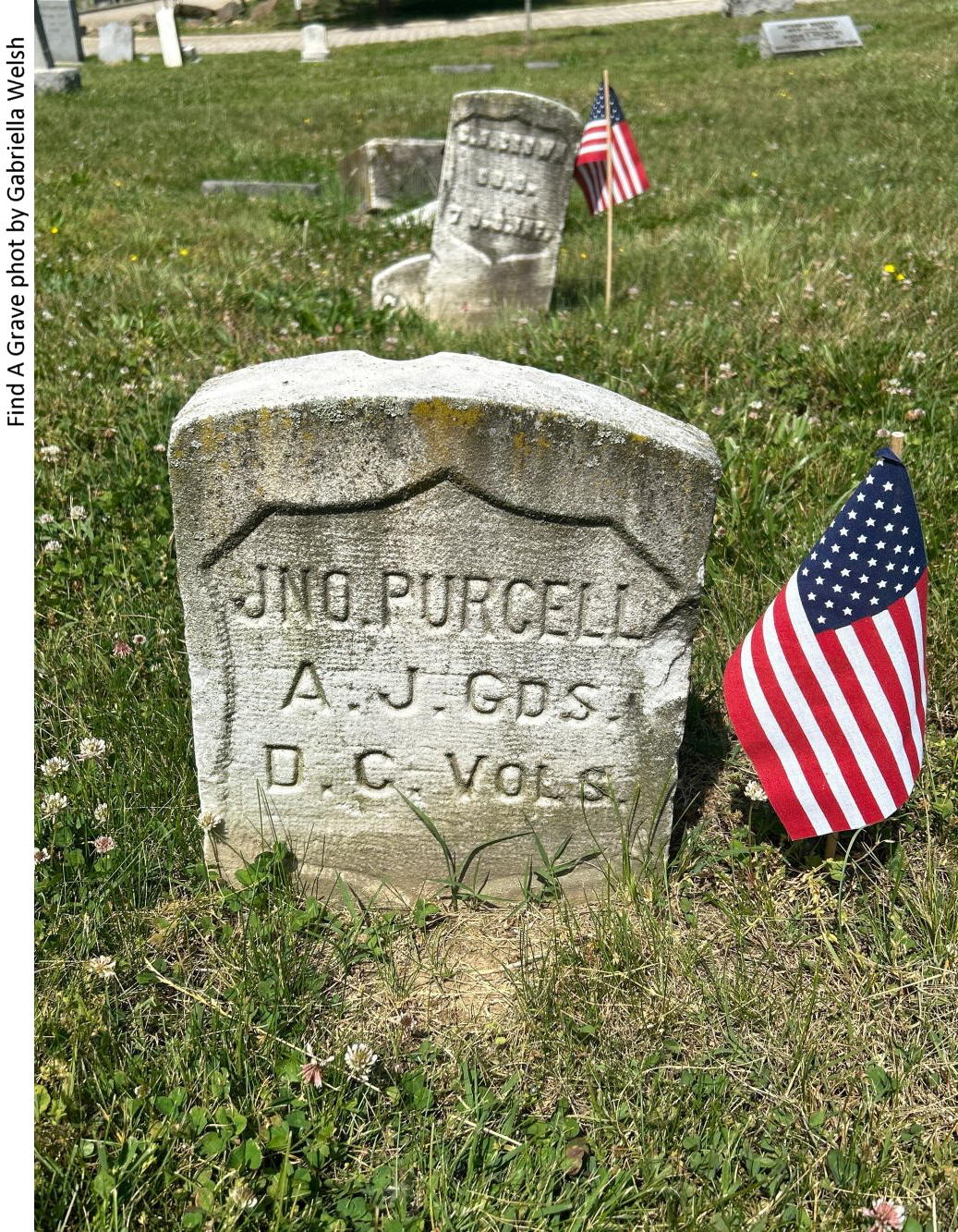
John Purcell had served in the Civil War, having enlisted on 23 April 1861 for three months as a Private in Capt. McBlair's Company, 1st Battalion, D.C. Militia ([Vice President] Andrew Johnson Guards). On 2 July 1890 John applied for an invalid pension, which was granted. He was in poor physical condition after the fifteen foot fall, and all through his years with Sarah—his health deteriorating more each year. His pension stopped when he died. Up until 1890 the U.S government granted Civil War widow's pensions only to widows of Union soldiers who had died in the war. The Pension Dependent Act of 1890 extended these benefits to widows of honorably discharged Union soldiers who had served for at least three months, provided these women had married their soldier husbands prior to 17 June 1890, the date of the act. Sarah applied for such a pension on 11 Jan. 1892 (six days after John died). It appears that daughter Kate spearheaded the application effort. Although Sarah was never granted the pension, the affidavits required to support it have provided the list of Sarah's marriages and also a list of John's six marriages, since Sarah (Kate, actually) had to prove that each of John's five previous wives had died.
George Washington Grindell died Feb. 15th, 1898, in Cumberland, and as we mentioned at the start, George's wife Ellen then sent a son (Will or Edward, most likely) to visit Sarah at Kate's house (the Wests had moved to 467 N street SW within the past year) to let her know that George had died. It's plain that neither Sarah nor Kate had heard from George since he went west almost thirty years earlier. Perhaps it is understandable that Sarah seemed to disown him. Or perhaps he went west because of a rift with his mother. Or perhaps Sarah was in such poor mental condition by 1898 that she simply failed to remember George. Kate asked Will (or Ed) if her brother George had married under the name "Grindell," perhaps because she was surprised that it was not "Grindall," or perhaps because he was "George W. Duvall" to her at the time he went west, or perhaps because she thought he knew of, and had taken, his father's surname.
A curious special dispatch from Cumberland to the Baltimore Sun, published on Feb. 17, 1898, included this: "George W. Grindell, who came here from Baltimore and helped to build the Baltimore and Ohio rolling mill, is dead, aged forty-nine years. He has a brother on the Baltimore police force." We have not been able to determine who this brother could have been.
|
|
|
Children of Kate (Duvall) and John West |
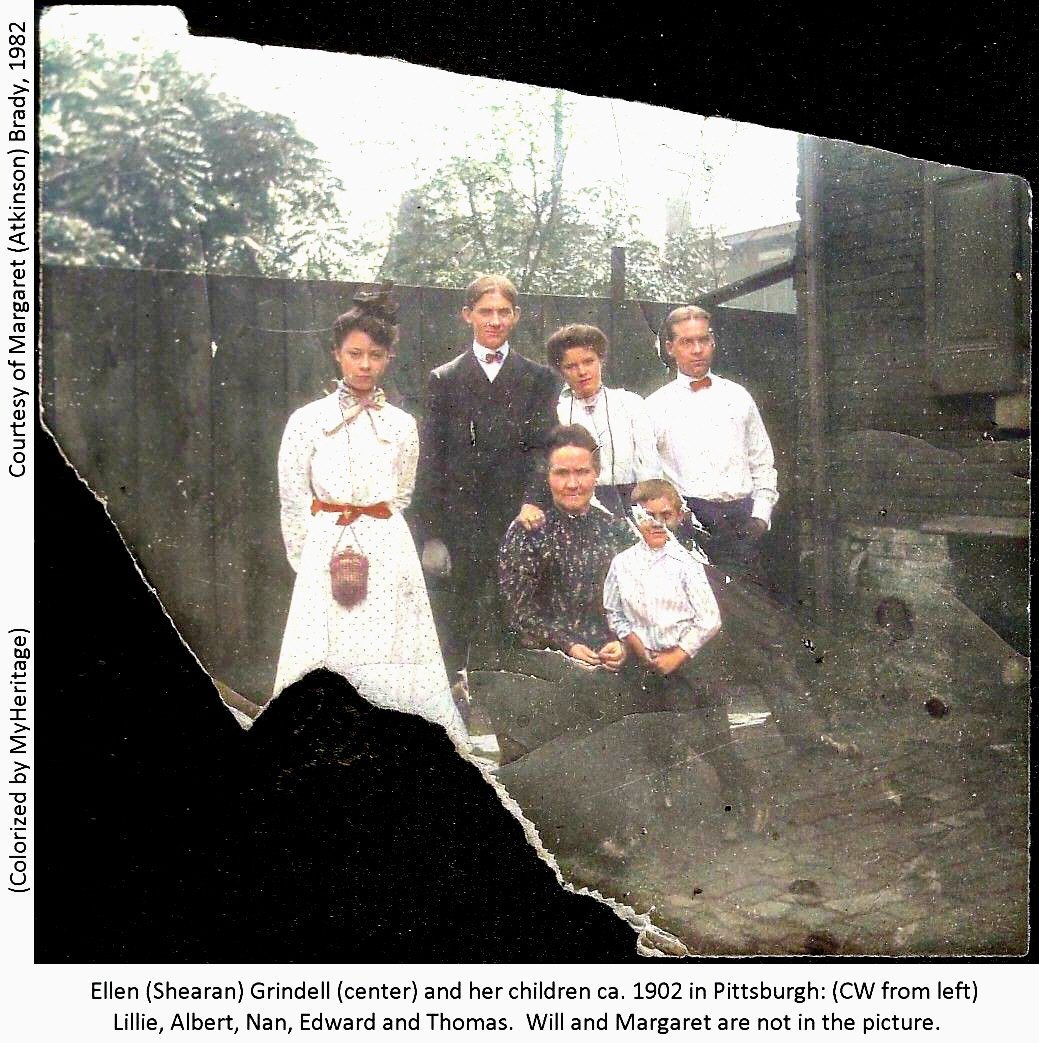
"Mrs. Laura Hayes," of the 1898 letter, was indeed George's (first) cousin. Her mother was Susannah (Grindall) McAllister, daughter of the above-mentioned William Grindall in whose household Sarah and George were living in 1850. In fact Susannah and Daniel McAllister were in that year living in the household enumerated just after William's. Daughter Laura McAllister was born four years later, on Feb. 28th, 1854. Laura married William Hayes, a railroad conductor, in Baltimore in 1869 or early 1870. In 1900 William and Laura Hayes and family were living in Baltimore, at 11 East Fort Avenue, which is probably where Ellen went in 1898 to interview Laura. (This was two doors away from 7 East Fort Avenue, where Conrad Aloysius Atkinson lived, whom Ellen's daughter Margaret would marry six years later.)
|
|
|
It may be that Sarah responded, or would have responded, to Ellen's letter, and might soon have established a rapport with her grandchildren by George; but it could also be that she never even saw the letter, since she died on September 14th, 1898 at her home (Kate's house), of a stroke, at age 68 (actually 75). She had lived long enough to get to know her six grandchildren by daughter Kate, but not long enough to meet but one (briefly) of her grandchildren by son George. And George had six nieces and nephews in D.C. of whose existence he may have been unaware.
This ends our new story of Sarah Ann (Grindall) (Duvall) Purcell. There's a lot that we do not know, of course, and may never know; but we would never have learned even this much had it not been for that draft of Ellen's letter to Mrs. Sarha A. Purcell, found amongst the papers of William T. Grindell, in his house after he died in 1961.
Here's a transcript of the draft letter (or see image of original):
|
Mrs. Sarha A. Purcell |
References
1. Lithograph printed by E. Sachse & Co., circa 1852, "View of Washington," a birds-eye view of Washington D.C., looking west with the U.S. Capitol in the foreground. Libary of Congress reproduction no. LC-DIG-pga-02581.
2. A contemporary (1874) account of conditions at the Washington Asylum may be found in Washington, outside and inside ..., by George Alfred Townsend. You might want to start from near the top of page 225.
3. Washington City, D.C., (part of) map; surveyed and published by A. Boschke, 1857; Library of Congress call no. G350 1857 .B63. House numbers were located using the 1888 Sanborn Fire Insurance maps for D.C.
Library of Congress, Sanborn Fire Insurance Maps for Washington, D.C., 1888 (image 1 shows Union st. SW in block 502 [no detail map] and BEP in block 231 [no detail map]) and 1904 (Map 212 [image 98] shows Union st. [5th st.] and N st.; Map 211 [image 97] shows Gorsuch Chapel ["M. E. Church," at 456 L st. SW]).
4. "Making Cents," by Dr. Sol Taylor, The Bureau of Engraving and Printing, 3 Jan 2009.
5. Bureau of Engraving and Printing, Washington D.C., 1878, painting by Jas. G. Hill, architect, American Architect and Building News, 7 Dec 1878 [Internet Archive link].
Please refer to our records history for Sarah A Grindall page which contains all the detailed further references for this story, in chronological order.
Comments? Criticism? Additional information? Contact Conrad Terrill at cwterrill@comcast.net.