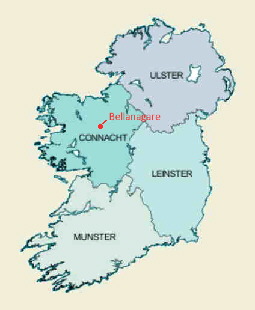
Ireland Provinces, Counties, etc.
(National Library of Ireland, interactive)
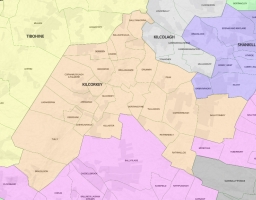
Kilcorkey (Frenchpark) townlands
(John Grenham, interactive)
| Devaney Project |
Ireland of the Devaneys and Higgenses
by Judy & Conrad Terrill, last edited 25 May 2024
Click on an image to access a high-resolution version
|
Ireland Provinces, Counties, etc. |
|
Kilcorkey (Frenchpark) townlands |
This is part of the stories of the families of Michael and Mary (Noon) Devaney and of Thomas and Mary (Coll) Higgins—a part which provides the background information for those two stories. Michael Devaney and Thomas Higgins were tenant farmers near Bellanagare, County Roscommon—Michael in the townland of Arraghan and Thomas in the townland of Killaster, both a mile or so southwest of Bellanagare. Judy and I are not historians. We hope that our glib summary of a very complex history does not get us into too much trouble. Our purpose is simply to set the stage for our two stories.
Before starting into history, though, let's get a grip on where Bellanagare is. Ireland is divided into four provinces (see the interactive map at right). There are many different types of Irish subdivisions, some of which are less commonly used and not of interest to us at the moment. So, for us, each province is next divided into counties, then civil parishes and then townlands. The townlands of Arraghan and Killaster are in the province of Connacht, county of Roscommon and civil parish of Frenchpark. You can see these divisions in that interactive map at top right by clicking on Connacht and then Roscommon. You can then view the townlands in Frenchpark (formerly called Kilcorkey parish) in John Grenham's interactive map. The word "townland", by the way, goes back a thousand years or more, and should have evolved from Gaelic as "homeland", meaning the home land of a family or clan. zx5
The Irish Penal Laws bear heavily on the history of Catholic Irish. Since the 1600's those Irish had been repressed, their lands were taken from them and the displaced driven to the less fertile lands to the west and south. "To Hell or to Connaught!" was Oliver Cromwell's famous policy declaration of the 1650's (put succinctly, perhaps). Catholics experienced gains and losses over the next century and a half, but losses prevailed, and once noble families descended into peasantry. The penal laws made Catholicism, education and the Gaelic lanuage itself illegal, forcing Catholic clergy into hiding and holding secret "hedge schools" to educate the young. In the very late 1700's the British relented, somewhat, for fear that the Irish might ally with France or Spain and bring their enemies closer to Britain. Charles O'Conor, of Bellanagare, was one of the eminent Catholics pushing for this reform. Catholics were again allowed to build churches, called chapels to avoid demeaning the Anglican (Protestant) real churches. But the Catholic Irish were still required to pay tithes to the Anglican Church, and very few were allowed or even able to purchase land. Almost all paid "rack rent" to landlords to lease landholds, under threat of eviction if they failed to pay.
National schools were established in the 1830's, offering education to children of all faiths, although there was reluctance by many to allow their children to attend schools managed by other religious groups. As late as 1870, 97% of the land was held by landlords, and Catholic tenants were still required to divide their land equally between all their children upon death. The first of the Land Acts, beginning to allow tenants to purchase their farms, was enacted in 1870. Still, for most Catholic families, the children's prospects were bleak, for acquiring land, marrying, and starting a family in Ireland. They were hearing from friends and relatives who had chosen to emigrate that the prospects were much better elsewhere in the world.
On small farms throughout Ireland large families were barely surviving, on diets consisting primarily of potatoes. The Great Potato Famine (1845 to 1852), along with other less severe potato famines, hit these families hard. Many were not able to keep up with the rent, and were evicted from their homes. Many died.
The families in Bellanagare were luckier than most, in that their landlords were Catholic. The O'Conors of Bellanagare were once landlords of a large area surrounding the town. They, the descendants of kings of Connaught, including two high-kings of Ireland in the 12th century, were stripped of all their lands around the year 1700. This confiscation was part of a general series of confiscations which from 1641 to 1703 reduced the Catholic ownership of profitable land in Ireland from 59% to 14% of the total. With the help of a famous Catholic lawyer, Terence MacDonough, the family was able to reclaim a small part, 500 or so acres, of their estate in Bellanagare, for which they were required to pay an annual rent of £79 to John French, of Frenchpark, a Protestant. zx1 According to family tradition, the heir, Denis O'Conor, living in a mud hut in County Sligo at the time (around 1710), was so poor that he had to walk barefoot to Dublin to sign the papers. He was said to have advised his children never to be impudent to the poor because "I was the son of a gentleman, but you are the sons of a ploughman." zx2 Denis built a house in Bellanagare (labeled "Mount Druid Ho.", near the old Kilcorkey Church & Nunnery on the 1837 Ordnance Survey map, sheet 21, top center), the ruins of which still stand today), which became a haven for all who espoused the old Gaelic culture.
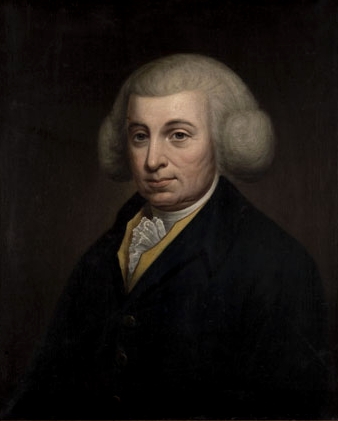
Charles O'Conor (1710-1791)
Denis's son Charles O'Conor (1710-1791) was raised in this environment. Schooled by Catholic clergymen and scholars, he was educated in natural science and Gaelic culture, and became famous as the primary antiquarian who rescued the ancient history of Ireland, rendering it readable to the Irish of his own time. As a champion of Catholic emancipation he advised non-belligerence and peaceful reasoning with Protestants as the best way to regain the rights which Irish Catholics had lost. He wished to show the world that Irish Catholics were not backwards people, as generally portrayed by Protestants.
It could be that all the Ballanagare O'Conor landlords following Denis and Charles felt the same way—we do not know—but it appears that they were well remembered. The landlord in 1857, at the time of the Griffith Valuation, was a Denis O'Conor. John James Kelly, of Arraghan, Bellanagare, wrote a story called "The Landlord" for the Schools' Manuscripts Collection, of 1937-1938, a collection of stories written by school children based on interviews of one old person each. John had interviewed Mrs. Mary Kelly, of Arraghan, age 90 (so born around 1847):
"Our local landlord was C.M.O'Connor of Mountdruide. The O'Connors have been settled in our districts for about a century. They were extremely good and generous to their tenants and they were looked upon as very kind landlords. They never evicted tenants who were not able to pay their way, but always helped them out as far as can be remembered. The O'Connors inherited Mountdruide and the property from their ancestors."
Just about all the families in Kilcorkey Parish, including the Devaneys and Higginses of course, were Roman Catholic. Their parish church (chapel) was in Bellanagare, built in 1819 by Denis's (of the 1857 Griffith Valuation) father, (another) Charles O'Conor. Rev. Patrick McDonagh, the pastor of Frenchpark/Ballinagare Parish, who lived in Bellanagare, baptized all the Devaney children except Maria (who was baptized by another pastor), and most of the Higgins children. Rev. McDonagh died in Bellanagare a few months after baptizing the last child of the two families. Peg Cahill, of Bellanagare, another school child who contributed to the Schools' Manuscript Collection, wrote a story called "The Parish of Kilcorkey," after having interviewed James Finnerty, of Knockroe, Co. Roscommon, age 80 (so born around 1857):
"The parish in which I live is called the parish of Kilcorkey but in olden times it was know[n] as the parish of Frenchpark as the parish priest lived in Belanagare and the Curate lived in Frenchpark. The last parish priest that lived in Belanagare was Very Rev. Patrick McDonagh. The Belanagare side of the parish includes the district of Tully, Castlecole, Kilaster, Kilcorkey, Derreen, Knockroe, Drummin, Corrigeen, Rathnalog, Kilvoy and Ballyconboy.
When stations were held each priest did his own side of the parish. Long ago one mass was said on Sunday and two at Christmas and easter. The parish priest now lives in Frenchpark and the Curate in Ballinagare. It is about sixty years ago since the parish priest went to live in Frenchpark."
This should do, as background for our two stories. We didn't want to add all this to both. You can continue on to:
References:
Images:
Further reading:
A Michael and Mary (Noon) Devany Story
A Thomas and Mary (Coll) Higgins Story
zx1. Brady, Colin. "Medieval Memory in Eighteenth-Century Ireland: The Reconstruction of the Gaelic Past for an English-Speaking Audience in the Writing of Charles O'Conor." Proceedings of the Harvard Celtic Colloquium, vol. 39, 2019, pp. 91-108. JSTOR link.
zx2. The Irish Aesthete (a blog by Robert O'Byrne): "Disregarded," 2 Nov 2020,
link.
zx3.
"The Landlord", by John James Kelly, of Arraghan, Belanagare, Co. Roscommon, informant: Mary Kelly, Arraghan, age 90 (so b. ~ 1847). The Schools' Collection, volume 0244, page 013; School: Bullach; Location: Castlerea, Co. Roscommon; Teacher: Máire Ní Fhlannágain.
From "The Schools' Manuscripts Collection" of 1937-38, some 100,000 primary schoolchildren from over 5,000 schools collecting lore and local history from neighbors, parents and grandparents. Dúchas © National Folklore Collection, UCD is licensed under CC BY-NC 4.0.
zx4.
"The Parish of Kilcorkey," by Peg Cahill, informant: James Finnerty, age 80 (so b. ~1857), Knockroe, Co. Roscommon; The Schools' Collection, volume 0244, page 156; School: Bellanagare; Location: Bellanagare; Teacher: Seán Mac Dochair.
zx5.
Letter from Ireland (blog link), Mike and Carina Collins, 28 Apr 2024, "Clearing the Confusion - The Origins of the Irish Term "Townland".
Charles O'Conor, (Irish: Cathal Ó Conchubhair; 1 January 1710 - 1 July 1791), also known as Charles O'Conor of Belanagare. Source: Royal Irish Academy. Wikimedia Commons link.
Note: Charles O'Conor (1710-1791) was never the Don (head) of the O'Conor lineage (as indicated in this Wikimedia file), although his grandson Owen O'Conor (1763-1831) became the Don in December 1820, upon the extinction of the former Don line.
Dissertations on the History of Ireland, by C[harles] O'Conor, Esq. (1710-1791), Dublin, 1766, 394pp. Internet Archive link.
"Charles O'Conor [1710-1791] of Belanagare: An Irish Scholar's Education," by Dr. Charles O'Conor (1764-1828, his grandson). Studies: An Irish Quarterly Review, Vol. 23, No. 89 (Mar., 1934), pp. 124-143. JSTOR link.
Corrections, comments, complaints, etc.: (contact Conrad at cwterrill@comcast.net).